Playmatches for ANDRES
on KOBULETI PROMENADE court
in a week's window:
![[image]](/graphics/tetris/o-block.png) Saturday 11:00am-1:00pm;
Saturday 11:00am-1:00pm;
A couple years ago a public tennis court was built next to the magnetic sand beach promenade and Kobuleti Central Park. In the summer of 2026, a singles ranking tournament will be held after some delay to celebrate its first anniversary.
Basic tennis instruction is available to help you get prepared for this event. The lessons in 2026 can be given in English (or in Estonian if you happen to belong to the virtually non-existent minority here who speak it), preferably, or in Russian (or perhaps even in Swedish or Finnish after some additional research on tennis terminology in these languages should such demand from people up there become a reality way south on the eastern coast of a distant sea during the tourist season) with a somewhat restricted vocabulary on the instructor's side. Let's hope the organizer will catch up on Georgian by the next time the singles ranking tournament takes space here in order to be able to show respect for the local culture and give instruction in the local language. You are welcome to join us!
Facing opponents at about one's own level of play in competitive situations can do miracles with footwork and coordination in recreational tennis, so it is always interesting to see toward the end of the season how players at or near beginner level like the guy above will be smash-and-volleying on the line run right after our looong summer tournament.
Such one-to-one instruction is available well into the high season for the quickest to sign up and willing to participate in competitive play to celebrate this excellent public opportunity to play tennis in Kobuleti. You can ask Andres about tennis lessons in the Big Tennis Kobuleti group in Telegram or on court during TODO: his practice sessions scheduled in our Requests for Play Matching Tetris (please be considerate and don't do so before or during tournament matches and instruction sessions after the mock widget is replaced with a real one, thanks) to get your tennis skills to entry level or brushed up for a more competitive level of taking part in our singles ranking tournament or to sign up for a test set to make sure you end up in the round-robin group that best matches your current level of play.
![[image]](/graphics/tclogo.ico) Requests for Play Matching
Requests for Play Matching
Playmatches for ANDRES
on KOBULETI PROMENADE court
in a week's window:
Saturday 11:00am-1:00pm;
Morning practices in the lowest price zone are reserved for one-to-one play. The rest of the practices can be group practices too, but as tennis is a very demanding sport in terms of attention, group sessions are probably not worth the resources, except for a very limited selection of drills.
Please submit your requests for instruction by noon of the day before meeting on court at the latest but preferably at least half a week earlier as the only public tennis court in Kobuleti so far tends to be crowded already and might well not be available just a few days before the desired time of taking instruction. For the same reason we can't have lessons more than a total of 3 hours/workday and max 2 hours/day on weekends.
You are encouraged to compete or just practice with each other after each instruction session to let the techniques covered in theory properly sink in to your procedural memory and expose the remaining gaps with practice that need further instruction. You can find most of the topics covered in our tennis lessons in the self-assistance program below to help with your experience of competitive play in our carefully selected community of recreational tennis players and meanwhile practicing on your own.
As the overarching main part of our instruction program is competitive play in the matches of our singles ranking tournament, let's start with all you need to know to make an informed decision, sign up, and participate, followed by a technical reference for those who need to brush up their stroke or footwork technique before the tournament commences or pinpoints the parts of your technique during competitive play that need to be worked on additionally. The following can also be viewed as practical advice from the Tennis Contacts community in Tallinn to the participants of the first Tennis Contacts tournament in Kobuleti, based on 25 years of experience. To fully understand and appreciate the following as you read it, however, we recommend that you try to imagine that YOU are the designer of the genuine long-term success of our tournament – is there anything you'd really have done differently to provide a sound practical philosophical framework?
The way we'd find it practical to design a singles ranking tournament is to start with the following tournament core values overview, i.e. introduction to the spirit and the philosophical setup of the event, given the situation we are in currently with e.g. war refugees from one or both sides of the proxy grinder in Ukraine flooding the streets of our countries and many bribed proxy puppets in state apparatuses demanding more of it. This overview is intertwined with chunks of currently popular genocidal international politics as an ugly yet very poignant example of where our tennis skills at soul health level really matter, but these skills are much more general, of course, than just beating an opponent on a tennis court or successfully troubleshooting the abuse of authority in international politics. Or on the tennis court of a problem university, to share some high-precision personal experience below, likely to end up being useful to many fighter hedgehogs of the world reading this.
In fact, the design of our tournament at its spiritual core is transparent to any particular political issues but not to the underlying opinions on why we should keep the ball in play and what the spiritual common denominator of the participants being welcome here need to encompass, which makes the Kobuleti Opinion, not Open, a natural choice for the name of our tournament. Such design choices draw from the experience of our recreational tennis community at Maltech (Tallinn University of Technology after having been ideologically hijacked by the, say, billmasons from Microsoft, that is), where we have been active for more than a couple decades already. For simplicity and brevity, however, we use our current reality in international politics to explain a few spiritual issues with competitive tennis below and hope that you bear with all the ugliness that comes with it, but as a result you'll be able to quickly evaluate the kind of skills that our Opinion has been designed to help you acquire should you decide to participate. We hope that helps.
Let's start with against the backdrop of our recent global jab blackmail apartheid, designed to discriminate against any players disobedient to the corresponding brutal abuse of authority by blocking their access to tennis facilities along with trying to mess up the rest of our life in the same fashion, in the tournament organizer's experience and opinion. Before we begin, rest assured that you don't need to follow any links beyond the first three videos embedded below to get a good enough idea of the spirit of our event and to successfully sign up and participate; more info is attainable via these additional links just for those of us interested in digging deeper and having the time to do so. However, you should at least skim through the relatively lengthy linear flow of the following thoughtful overview to developing a competitive mindset in international context far beyond our shared interest in tennis to get a solid idea of what competition in our community in its intended depth really is about.
To zoom in properly on the importance of the impact that competitive tennis matches at even recreational level of play have on us, let's first make the observation that while we are dealing with a totalitarian regime lurking around the corner on a global scale since 2019 with plenty of evidence that even the average Biden can't ignore anymore, tennis has something very valuable for our communities to offer. It's about finding the optimum between excessive courage and excessive caution, both extremes being manifestations of a lack of character, to be honest, known in tennis as playing like a banger and playing like a pusher, respectively. On a tennis court, the banger and the pusher phenomenons often manifest in physical actions like recklessly overhitting the ball or hitting, say, topspin drop shots designed to beg the opponent to commit an unforced error, but sometimes this kind of cowardice can at least for practical purposes stay within the invisible spiritual realm completely. Playing at these extremes has a lot to do with not respecting your opponent properly, which is what pretty much every totalitarian regime is about, so we should train certain spiritual muscles that we use to counter-cancel such regimes in tennis matches.
Our habits make up most of our counter-canceling power, so that's what we should be relentlessly working on for a game changer in our current reality. The following display of not just bravery but also the consistency in sticking to one's own understanding of the situation needed to counter-cancel our current BS pushers (or should we rather say "BS bangers" about the drivers of the current notably rude totalitarian approaches to governance in the Western world these days?) with canceling ambitions successfully and a poignant example of the importance of being properly trained for finding the optimum between the two in critical off-court situations. And rewardingly enough for us as personalities, this kind of taking action during times of trouble lets us live the experience of directly feeling the value of getting on the track of leading a spiritually respectable life in the process.
In tennis, such a high-performance zone around the imaginary optimum of acting with integrity is called percentage play, and your ability or inability to put up an extended fight at this level of play, or in more general terms, behavioral mode of operation, tells something important about your spiritual stamina, largely reflecting your overall soul health. It's like a mirror of your soul and the spiritual power available to you not just in a tennis match but also in the reality of your off-court fields of expertise. And perhaps the most important byproduct of percentage play these days for the human communities practicing it is their IMMUNITY to canceling and other manifestations of the currently popular divide-and-conquer scheming of, say, the spiritually anemic power grab "elite" (or, depending on the context, the de-souling "elite" or simply the abuse "elite" for those of us who haven't advanced beyond judging by the effects rather than by the causes), trying to specialize in the abuse of authority to run the world in a totalitarian fashion for robbery to consolidate such power, basically – without respect for one's opponent, to express it in tennis terms. These robberies include economically motivated power grabs to pit any potential resisters against each other brainlessly along the lines of the vaccinated vs the unvaccinated, pushing entire neighboring nation states recklessly into war against each other, and other nasty means of robbery cover-up by divide-and-conquer scheming asking for troubleshooting from the rest of us. A big thanks for making intelligence like this as Open Source as possible!
Effective opposition to disrespecting one's opponent, on the basis of sound moral values unlike clinging to power by means of theft or robbery, for example, is called leadership, which assumes being in respectable soul health. Now let's see how the de-souling resistance elite – or abuse resistance elite, to be exact – can troubleshoot propaganda-loving bastards type of "elite", skilled in slipping into our governments and other power positions, in recreational tennis communities properly, starting with a core value that expresses what we are NOT going to let take space at the Kobuleti Opinion. Based on plenty of practical recreational tennis experience from academic settings in Tallinn, Estonia, we are not stupid enough to let any divide-and-conquer (conflict-provoking) abuse specialists prey on the variety of OPINIONS in our carefully selected recreational tennis communities like the participants of our Opinion in Kobuleti, Georgia, optimized for getting along with each other in tennis matches, alright, by not letting anyone conquer the spirit of our connecting ether by nefarious scheming designed to disintegrate healthy self-defense and the communities practicing it. Other than eliminating malevolent spirit designed to thwart good intent, however, we are normal people minding our business and polite enough to try to keep politics and other annoying manipulations out of our conversations.
As an example of what SHOULD concern us as the equivalent of the abuse resistance elite and can't go ignored, well, an interesting opinion about the demolition of the Batumi BNZ clay courts (the very best surface for extended tennis rallies there is) that is about to begin "soon" for three years in a row already is that at the end of the day it's about losing ground in your soul health territory for the reasons being described above and below, dear Georgians, so perhaps 2026 is a precious time for you to wake up and do something about this threat to your own soul health...
As another core value, to generalize our take on having an opinion in accordance with our percentage play take on competitive matches on and off tennis courts and stimulated by the nasty on-court practical experiences of those of us rejecting blackmail jabs, finding ourselves being blocked from tennis courts during the last lengthy global scamdemic that doesn't have anything to do with the reasonable management of tennis facilities nor respectable soul health, we are not going to be stupid or mess with our language and leave our tournament OPEN to any contagious malevolent intentions in general, including the abuse of authority by denigration campaign specialists, attacks on targets selected on the basis of being protected by public incredulity, and similar currently popular undercover aggression. If you are interested in what exactly is being meant here and what we should do about it, you can join a community of independent minds like ours trying to cooperate with each other to e.g. hold a tournament and keep a public tennis court usable in a partially hostile environment as far as the so-called change agents, a.k.a. New World screwworms, are concerned who for some reason seem to always find their way to our events, be they organized in Estonia or abroad.
A little example of the shortcomings of such screwworms is given in the Q&A section for our up-and-coming local soul health elite to give you an idea of how to keep the global masonic screwworms – and their local proxy screwworms for that matter – honest as they try to specialize in fooling the public for power grabs in our societies currently, typically using a combination of deception and denigration. We hope you find it useful in blocking the canceling of a local keep-them-honest soul health elite yourself successfully. You can also watch the following video as a kick-start for understanding where such surprise members in your communities originate in, and find more episodes of such professionalism to drive the abusers of authority out of power on Dr. Desmet's, Dr. McCullough's, and John Leake's Substack profiles.
Which brings us to the overarching subject of masonic satanism. Its practitioners are a global cult, currently specialized in hijacking pretty much every bit of public administration for the global total control of every aspect of our life, it seems, by bribing our parliaments and governments and apparently using bioweapons for eliminating resistance to the illegal takeover of our independence at our educational institutions, for example, to name a couple of their activities that we have bumped into in Tallinn over time and would like everyone to watch out for (sorry about the rushed and incomplete report on the slightly broken Stop Maltech website, need to find the resources to update and complete it properly; an even more quick-n-dirty cover story on Substack is available to give you a preliminary idea, too). Furthermore, the testimonies of many brave survivors of ritual abuse and other resisters, who have been able to speak up over time, give you an idea of the true nature of the freemasons and their cult, the hidden facet of the masonic activities, known as ritual abuse in private and kind of still being covered up as masonry in public just to mislead the unsuspecting majority of us, and their masterplan to corrupt the women for world domination (scroll down to "since we cannot get rid of women, let us corrupt them with the Church" to get an idea how). A big thanks to everyone wise enough to hold in public contempt the slut mentality that enables theft and robbery as THE nail in the coffin of our societies, making Europe, for example, uninhabitable for those capable of creating genuine value wherever it won't get destroyed or stolen!
The Zionists have taken masonic satanism to their historical trademark level, of course, with the manufacturing of a whole new servile proxy species among us that we can call Cockroach sapiens – a propaganda tool for pushing everyone toward their insidious agenda as usual, basically. The public interface of masonry, however, is there to get you thinking along much different lines. This is what Google AI wants you to believe under the "facts" section, for example, as you type in "masonic satanism": "There is no link between Freemasonry and Satanism." Well, as the the 50 voices describing this hidden facet of the masonic activities have just proven above against the backdrop of this kind of "fact-checking", Google AI is nothing more than yet another little propaganda tool of the ruling gang of robbers, so never trust the AI when it comes to more than just generating some JavaScript code for your website, alright, that you can verify as correct or not right away. As such that the so-called AI can come up with is truly undermining our effort to drive the abusers of authority out of power, let's keep our language reliable and call it Hedgehog Intelligence (HI) instead.
If these couple preliminary paragraphs about masonic satanism got you interested in Little Hedgehog and what the hell is actually going on around the corner, including how this helps you further understand the design of our little recreational tennis tournament being discussed here, then you are most welcome to make this entire overview to our Opinion about double longer and start living with your eyes open to see what can be done about a Nazi regime (a DEI/stakeholderism combo, to be exact, that also gets discussed in the slightly longer version of this intro) around the corner waiting to be imposed on everybody again, about 4 generations after the last attempt by the usual suspects.
What else comes handy to know about the freemasons in our current reality is that they have already had many chances of bribing everyone of high social status or promising to get there, most probably, and there are many corrupt people around, irrespective of their social status, just waiting to become illegal proxies... As we learned above thanks to a brave whistleblower of the Estonian parliament (sorry about the missing translation, more about them in the FYI section below), the MPs in Estonia in general are bribed by millions of euros per puppet to stop the legal functioning of the parliament by inviting all the bribable nerd professionals among them to betray their people and having their souls sold to the cult in the process, which has apparently been accomplished successfully in the majority of cases – bankers, politicians, sportsmen, and other professional freeloaders prone to unethical cooperation and thereby becoming screwworms within their own people. Outside the legislative and executive positions of power the masonic bribery has successfully found its way to get a mass of doctors, businessmen, lawyers, and just about any other proxy screwworm in or dependent on the state apparatus inhabiting the body of a bribed host to follow the agenda of the remote screwworms as the remote ones just happened to find Estonia "a country with an interesting foreign policy" for their Greater Israel project.
Big Pharma is probably the most widely used financial instrument in their regime toolkit nowadays as the recent jab blackmail apartheid has demonstrated, and by the way, the solution to the problem of the early days of organ transplantation when the know-how was there already, but the finances were missing, and the gap between these two in the early nineties was insurmounteble for the European doctors, plain and simple, so they teamed up with the American businessmen. And guess what? The hijacking of state power in every corner of the world by means of masonic satanism very much looks like what these doctors and businessmen finally came up with after all their meetings across the continents to finance their selfish ambitions, the European doctors and the American businessmen working in close cooperation with each other. You could get the university costs of your kids off your back by just letting them get sucked into the cult. Well, didn't work out in some cases... But that's exactly how they did it in the general case anyway. And that's the point where the "healthcare", the banking system, and the law we have in effect today, to name probably the 3 worst consequences of letting flush our democracy down the toilet like that, are being replaced by the puppet theatre of a satanic cult of hijacking professionals who in Estonia and the States, for example, are predominantly of the Zionist stripe.
One more aspect of Big Pharma deserves even more attention than the Covid circus although, interestingly enough, it doesn't seem to be covered ANYWHERE. That's where REAL obedience comes from, which is why the doctors occupy the very first position of the list of tyrants just given. Imagine you are in your 60ies, not very considerate of other people and fat enough to have a high risk of landing on the health decline spiral of just a few years of end-of-life agony, and you get a heart attack... Your entire LIFE is literally going to depend on the competence, and increasingly more these days, on the good will of your cardiologist for the rest of your life in this situation. And on the guy, of course, who is going to do the surgery. Now imagine the kind of flattery that such kind of patients are able to come up with... And what if the doctors happen to be not very solidly grounded in ethics, or worse yet – happen to be members of a satanic cult (or the little department of it known as Big Pharma) with the ambition of world domineering and the inflated sense of entitlement that comes with it? With the help of just a little bit of vanity and arrogance, horrible crimes, protected by massive cover-up rooted in incredulity, can easily be committed with impunity in the reality that we are living in to pretty much any third parties, especially the whistleblowers, of course, but also to the minors who happen to be close ones in the process, despising the manufactured injustice that comes with people involved in satanic machinations, especially in the soul health territory, and thus offering no openings for getting them sucked into the cult. A big thanks to everyone trying to expose and disarm these bastards!
It is easy to see how many people under such circumstances are capable of doing just about ANYTHING to somehow get a life saved that THEY are interested in at the cost of many others they don't give a shit about, to be honest. And the little hedgehogs of influence up on their tree stumps can fart as loudly as they want in this situation without anyone reminding them of their earlier promise. If such influencer hedgehogs can orchestrate the hijacking of the administration of the Maltech tennis court – and the signs are they can – then they can do it pretty much anywhere. It's incredible what kind of abuses of position can crawl out of such a wellhead naturally should the ethics be inadequate or even discouraged as is clearly the case with the education system of the European empire these days – inadequate obedience lobbying, inadequate obedience harvesting, and so forth in the get-a-jab-or-lose-your-job fashiion. Let's call it the Zionist masonic pattern. It is fair to say that mass formation in the Zionist masonic "medical" business relies on inadequate obedience – take the inadequate obedience away and such mass firmation collapses. Such stupid obedience follows exactly the same pattern in modern "medicine" and the cult itself, so that's why our medical "care" has become so criminal so readily. This is the Estonian equivalent of the American Cockroach sapiens. Of the Zionist flavor, as soon as it comes to international politics.
The takeaway for the Georgians here, whose leadership hasn't permitted the EU cockroach to fully bribe its people yet, balancing skillfully between similar interests from China, EU, Russia, and USA in their economy, the importance of which the utterly incompetent leadership of Estonia fails to understand to this day, is that thanks to some very important decisions made by your leadership, your ability or inability to be able to live in your homeland isn't determined by the Zionist wasp unlike the case of Estonia and many other little countries it has pretty much hijacked fully by now where a political view you hold, your commitment to figuring things out properly, and similar can get you killed easily by the zombie proxies following the agenda of the intruder, just like in America, which is the worst that has happened to the Estonians by the 36th year of "independence" of the current streak of whatever it should be called instead. A people like the Georgians, who have been able to value and honor their independence more than many other small countries in the position of doing so but not having the brains to act properly, can now from a solid standpoint counter-lecture pathetic bribed propaganda slaves and instances of the Estonian cockroach like Margus Tsahkna or Kaja Kallas – in a more intelligent manner than theirs, of course – on the importance of having potential intruders from the East and the West counter-cancel each other, which can't be done with the mentality of a prostitute and a thief that the Zionist wasp knows all too well how to take advantage of.
Without the Zionist masonic kind of obedience support powered by international politics and the oiling of the international war machine that comes with it, the satanist tyrants at hospitals will, interestingly enough, have a great fall from their invisible power positions automagically over time, most probably. And last but not least, restoring order on the Maltech tennis court – or reasonable cooperation between the public and private sector in general – would make it happen notably faster in Estonia for sure IF (and that's a really, really big IF) the Estonians have the dignity as a nation to decide to kick their fake elite into the dustbin of history. To be honest, that's a major reason behind why our Opinion has been designed the way has been designed, by the way. Thaese are the origins of the Estonian cockroach sapiens, what can be done about it to start with, and how the Georgians and other people not willing to lose their independence should interpret the lectures of pathetic bribed instances of the Estonian cockroach sapiens on the satanic version of independence, which means the exact opposite of it, you know.
That's a very concise little summary of the abuse of our societies in such ways that the "rights" of thieves and prostitutes can suffocate and strangle to death the independence of everyone acting with integrity, as evidenced by our Maltech case, for example. Such mindless proxy screwworms are very alluring prey for carrying out the illegal takeovers and the accompanying crimes the invading remote screwworms find "interesting", and the remote ones absolutely love sucking capable people into their cult – with much less luck than before reading stuff like this (so please share it with everybody, thanks!) – where getting rid of those of you not obedient to the regime has been almost as easy as squashing a mosquito so far, apparently. This kind of murderers, interestingly enough, are currently roaming among us with impunity so far, desperately trying to suck not-very-suitable people into their cult, judging by the sheer stupidity of the not-very-capable troublemakers among them trying to steer their ship that's about to hit a very solid rock, obviously (and, of course, thanks to the more capable people in respectable soul health for not joining this cult OR trying to undermine it from the inside!).
Let's see now what the female half of our sample six-pack of fighter hedgehogs has come up with. First of all, as most of them prefer to fight public ignorance with in-formation behind paywall, our readers from, say, North Korea have come up with an anecdote about the abuse of context to keep the little hedgehogs declaring a fight against the abuse of authority yet placing strategic in-formation they want to share with the world behind paywall honest.
A dictator is engaged in a heated conversation with the president of a neighboring country, bragging about his might. "Our cosmonauts are the best," he says. "They even went to the Sun." As his conversation partner starts arguing that it can't be true as it's just too hot up there, he decisively interrupts by introducing a brave new context that it's not a problem as they went there at night.
Actually, this anecdote serves currently more like black humor about a lack of wisdom and the corresponding fate of the majority of our dear readers really who decide whether our projects designed to troubleshoot the masonic grinder they'd better know how to do stay viable or disappear as a result of their lousy teamwork, much like the success of someone talking about the cosmonauts visiting the Sun at night depends on the limitations of the imagionation of their audience – or the complete lack of it. , or the fake fighter hedgehogs trying to make money off strategic teamwork information for that matter, why not put your soap operas, for example, or other non-strategic content behind paywall instead, or make it a friendly forgiving paywall for getting the strategic in-formation out as early and widely as possible to continue as a reliable coop partner? And regarding the link just given, optimized for free will, you don't need to click on any links in this flow to participate, as pointed out earlier, but thanks for your wise support if you choose to make a jump behind our friendly forgiving paywall, say, a friendly considerate exception anyway!
FYI! Also very importantly, it must be pointed out that in an effort to keep this text within the ten thousand word per initial read limit, the isolation of a lengthy commercial section from this flow serves as a means for keeping the rest of it shorter and more adequate in terms of meaningful speech. Some text and audio on this website or linked from other websites are not in English, so whenever a translate-button doesn't show up next to such multilingual sources used in the design of our Opinion, please use an online translator for Estonian, French, Georgian, Russian, Swedish, and Turkish input (you need to know the source language for audio input only; for plain text the "Detect language" mode should be enough), which within a reasonable effort by the author of this tournament's core values overview accounts for a minimized share of the overall information presented here for the convenience of the English-speaking audience, and in audio form can be translated with the online translator referred to earlier in this sentence in the Google Chrome browser, for example.
Now let's see in a concluding paragraph of what's supposed to be supported by our readers by means of a friendly forgiving paywall this time – or, say, a creative counter-canceling content retaining wall in a longer perspective – how the content published by the female half-sixpack of brilliant Substack minds matches our Maltech experience from 2002-2019, which is truly impressive and professional, by the way. As far as our experience with the march of the freemasons in woke costumes through the Estonian educational institutions is concerned, it's yet another brutal power grab, of course, with a combination of DEI and stakeholderism serving as the ideologically hijacked economic engine for the canceling and silencing of independent minds disobedient to a Nazi regime, basically, that is looking for openings to take root. The regime has plenty of so-called useful idiots everywhere, lacking self-discipline and ready to sell the independence of their people for personal benefit, and the woke subsystem of the regime in particular is tailor-made for promoting and brutally providing the worst proxy screwworms of their respective peoples everywhere, lacking accumen or worse, with such openings for exactly that kind of inside-job treason to be committed (betrayal of one's people inside its state apparatus, that is, financed by overseas corporations and enabled by brutally eliminating the local whistleblowers in our current reality), which no people cooperating with dignity would ever let anyone get away with. The implications of this little paragraph preview to what's behind the retaining wall are huge for fellow Estonians, so why not be so wise and donate while reading this lengthy soap opera that is otherwise going to be the last bit of counter-canceling help from here for a very long while, as it currently seems?
The more such proxy screwworms are bribed, the larger the army of revolutionaries to overthrow and hijack whatever the invader deems appropriate, by and large depending on the size of their budget only. As Tallinn University of Technology was hijacked before our eyes – right before the global jab blackmail apartheid to help cover it up, apparently, – we would like to inform the Georgian people, and any other people not suffering nationally from the mentality of a prostitute yet and thus able to see a problem with the canceling of their soul health elite, and selling the independence of their people to the international banking cartel for that matter, to really watch out what's coming around the corner. The situation is nothing new under the Sun, as you may anticipate, so some people still have the dignity to deal with it. There had better be local people around, capable of saving their personal or national dignity, or that of their family or our entire species, depending on where their scope of reasoning about this problem happens to be, and our Opinion aligns with that kind of dignity as long as not leaving space for potential cover-up hysteria is concerned, for example. See the reasons for the brutality now behind how these perpetrators are persecuting all the whistleblowers among us? May there be many more of us to make it impossible!
There is no bad without good, so after something like the robbery at Maltech, noticing patterns of evil around the corner becomes a reality. And because of that, further spiritual design of recreational tennis tournaments has become quite a straightforward task for us. Our hope is that the participants of the Kobuleti Opinion are wise enough to like it, and the local spectators are supportive, too. To begin with – the proxy screwworms distorted the information (both text and graphics, by the way, so they really worked on it as if working for someone's money...) set up by us on the university Web they were given administrative access to, then started blocking our tournament info from all student channels, and the leadership of the Student Union even ended up refusing to service requests from new students interested in playing tennis on campus, asking to change subject when confronted with inquiries about the abuse of authority at meetings gathered to solve exactly this kind of problems and keeping the inquirers waiting infinitely with promises they had no intention of keeping, so resistance to disrespectful communication style with extra attention of the tournament committee at least on meaningful speech will be the basis of the expected level of all communication, including any potential conflict resolution, of course, which tends to be particularly sensitive to shit in our communication ether.
Another peculiarity of the Nazi regime of woke flavor rearing its head at Maltech was the window dressing / brutal change of mind kind of circus with all the meetings being organized on campus serving the sole purpose of cover-up, as it turned out later. As protests from both the students and the professors started mounting after the hijacking of the administration of the university tennis court and the release of official utter lies to try to justify a plain and simple robbery with the results of failed provocations and pretexts right out of the blue, meetings were immediately organized, asking everybody to dive in with ideas about how to improve the situation only for our representative to learn at the meeting that everything had been decided already and it wasn't even possible to get the floor at the meeting whose declared purpose was the exact opposite, so we expect the integrity and dignity of each participant shaping the environment for fellow participants to be the equivalent of a respectable soul health elite or on their way there to at least show the way how the woke regime can't infect and undermine communities and thus take root locally where such openings are actively being blocked.
And not surprisingly, our third experience and conclusion that absolutely may not go unnoticed by the resisters of the abuse of authority is that the freedom of having opinions in carefully selected communities is not enough to thwart the onset of a totalitarian regime like wokeism – the vast majority of our community were against the abuse of authority behind the hijacking of the administration of the Maltech tennis court, many of them writing protests and setting up petitions, and risking to lose their job or study peace permanently in the process, but for the time being the proxy screwworms got their job done anyway because the administration of our university had already been bribed by the remote screwworms – predominantly the billmasons and the sorosmasons, most probably – to relentlessly ignore our inquiries, apparently. It is easy to see for the people of Kobuleti what you should keep an eye on locally for this scenario not to repeat on your premises, no matter how good the design of our tournament. In other words, we can't afford the abuse of the context that we are operating in, especially bribery by the worst international financial terrorists, so we'd better contribute to keeping those honest who have a say in what's allowed and what isn't in the context of Kobuleti.
Considering the current circumstances, the contribution that our Opinion is suitable for coming up with, demonstratively, to help keep the local elite of Kobuleti in respectable soul health by providing any up-and-coming proxy screwworms with ample opportunities to train their sense of proportion is to establish an academic quarter as the 15-minute tolerance of the delay of all our matches to keep the fans of the 1984 kind of punctuality away from the levers every time they happen to land in the position of trying to impose their lousy soul health on the context of our Opinion by means of the start of their matches at our tournament. Interestingly enough, the academic quarter used to be very popular at our university but got rolled over by the DEI regime shortly after ethics was removed from the curricula in Estonia and other shiny new members of the European Union. These three examples should give guys like Tucker Carlson an idea or two about where masonic puppets as pathetic as Kaja Kallas or Margus Tsahkna at top diplomatic positions originate in – our opposition to proxy screwworms has been brutally eliminated by the officials bribed by foreign capital through NGOs and other masonic proxies. That's exactly how the Nazi regime of the billmasons and the sorosmasons from the States has been deployed in countries like Estonia at the level of educational institutions, and a straightforward advice to the Georgians is to not let any arrogant administration hijackers into their notably independent country so far.
In addition to being a means for keeping our tournament in respectable soul health, you can also think of the requirement of not generalizing any personal opinions recklessly as the guiding security fix for our community to not become open to Trojan intent in Kobuleti as well as a role model for everyone interested in being wise enough to be willing to develop a widespread habit of taking this step back in order to avoid obvious stupid conflict that the divide-and-conquer specialists around the corner are fishing for to thwart the exposé. The hijacking of administration at Maltech was done by means of brutal breach of contract, silencing the crowd with the threat of losing one's job or being persecuted as a student, and apparently the use of some kind of bioweapon on the lungs of the author whose work was being targeted, distortion of information and similar abuses of position for blocking normal communication between independent minds, and the use of a combination of provocations and denigrating propaganda without giving the vast majority of the community the floor to prove the fabricated lies wrong. In Kobuleti there has been one more incident in addition to the one already mentioned that could be interpreted as systemic threat, but so far it can't be confirmed as part of similar canceling intent.
So, how can we troubleshhot the masonic bastards who are getting all too comfortable already with imposing their de-souling agenda on the world and covering up their crimes with Google HI as they shape our current reality with the orchestration of jab blackmail scamdemics, the hijacking of administration at Maltech and elsewhere, and other nefarious scheming along these lines? Well, leaning on our experience so far and in accordance with the core strategy of our Opinion, we are going to expose them with percentage play. We'll not be playing like a banger against their proxy screwworms, of course, which would be a huge waste of resources. Instead we'll EXPOSE both the remote screwworms and their proxies to help find the fate they deserve, much like life finally treated the abusive father of Huckleberry Finn who, interestingly enough, happens to be the main character of the piece of literature widely regarded as the best that the American respectable soul health elite has come up with so far. Examples of Huck Finn's Take a Step Back method on propagandist proxies trying to spread hysteria and abuse half-truths that we'll have been able to come up with will be reported in our Q&A section. Our point with this is to counter-cancel them not by direct confrontation but by exposing them persistently, bit by bit, so that the rest of the counter-canceling of the domineering proxies at least can be done by, well, themselves. And we aren't pushing anything either – let THEM do it and fail.
Now let's add a couple core values that we ARE going to let take space as important design elements of our Opinion. Firstly, to summarize what has been discussed behind our retaining wall, we pay a lot of attention to the skill of valuing good intent, i.e. constructive long-term intention, rather than being hysterical about temporary failures. The latter, although at times justified, can easily turn into a nasty counterproductive habit, prone to becoming a technique for covering up robbery, among other alarming problems, and thus blocking good intent and the free will behind it, which is probably THE nail in the coffin of the current European sivilization, the way Huck Finn referred to our civilization. And secondly, the wisdom of avoiding the overpopulation of the soul health elite or equivalent, that we would like to see participating in our Opinion, with those not sharing our efforts to keep our Opinion in respectable soul health, was also discussed as a core value in the lengthy thread behind our carefully chosen "paywall", thanks to which this top layer overview of the design of our Opinion can be kept way shorter now.
What is significant about these pairs of core values of our Opinion is that we need to make wise choices to be successful at achieving them. The freedom of having an opinion implies that we as a society don't let the propagandists abuse them, and the freedom of being able to value good intent implies keeping the de-souling "elite" honest and the respectable soul health elite adequate in size correspondingly, which in reality may well translate to blocking inveterate screwworms from our community of respectable soul health for the benefit of everybody participating. Such choices, however, had better be based on facts rather than aligning with the HS of someone equivalent to the Google Hedgehog Intelligence just diving in with a weaponized fake opinion – a practical reminder to the participants and the organizer of the tournament alike that there is responsibility involved, so being too assertive will result in the need to organize your own tournament or lose viable contributors to a pathetically managed event, respectively. In other words, we need to be good students for the teacher to appear, and inter-sivilizationally speaking, unlike the hysteria of the strong in theory and the lousy in practice, and all the trust as a process that never gets built in such hedgehogs and their societies, the soul health of those who stumble forward allows them to succeed in learning to appreciate and value a lot of rewarding intent worth saving out there. How about the delayed launch of our Opinion, for example, after its design finally made it to the web as a live tournament for everyone in the world to use as a role model if they like?
Now that we have our core values established, we should understand that with the freedom of having an opinion and the benefits of the perseverance paradigm come two core responsibilities that have to do with the training of our character by LIVING competitive play situations – our trustworthiness at all times as we play without a chair umpire and thus need to be extra considerate of Fair Play, and a display of competence whenever we lose as losing is part of competition and sometimes our opponent deserves to win. The current trends in international politics, however, are a poignant example of the exact opposite, demonstrating the absolute incompetence of REAL LOSERS, i.e. the worst losers from families with obvious problems with masonic satanism, who are somehow occupying our top administrative positions, which even recreational tennis matches readily expose as completely inadequate in terms of the position of those capable of actually creating genuine welfare in our societies – as opposed to the "success" of the glitter addicts – and, of course, defending it adequately. That's a consolidation of robber power, to be honest.
It is easy to see that we should do more in our societies for everyone to understand what a reasonable meaning attached to belonging to the elite is, what it takes to get there, and provide plenty of opportunities to find out on your own what the sincere speech challenge and other parts of belonging to the elite mean in reality. Our Opinion is designed to contribute to both understanding as well as living such challenges for an increase of our spiritual stamina in competitive recreational tennis matches and thus our better overall soul health. Among other benefits, very importantly, such explicitly declared soul health commitment helps keep the meaning of words like "open" and other language we'd like to use normally from veering into the territory of the exact opposite. As a joke, let's hope the rest of the herd will follow us to blur the line between our respectable soul health elite and a vast mass of slow-wits for the peace of mind of every little hedgehog involved in their particular way (only the preamble anecdote being relevant here about an unprincipled member of the cheap-talk herd trying to not look stupid after the gap between their theory and practice has been exposed and become an obvious reason or two for not being called the elite). Nobody likes sore losers or recreational tennis communities hosting them, and that's why they should never occupy any power positions, so let's do our share to kick them out of there by not being open as communities in suicidally stupid ways to such kind of screwworms, alright.
Regarding shallow culture and the lack of trustworthiness that plagues it, well, the main problem here is that we won't have a functioning belief system at the end of the day, nor a functioning society for that matter. And using our healthcare system as an example again, it isn't that much different in the East and in the West as far as the abuse of our trust is concerned. If we don't want to find ourselves at the mercy of someone who hasn't learned to lose properly or is servicing entire cabals of such bastards, roaming freely in our societies, with invited "guests" on their private island in our current incredible times of meaninglessness then we'd better get at least our elite in the spirit and habits acquired from having played exhaustive percentage play matches to become adequately skilled at detecting and addressing such problem behaviors to protect ourselves, our close ones, and our societies from sore losers and other abusers of our trust due to something like not having LIVED a sufficient weight of such educative matches as the one demonstrating the historic choke on red clay presented above to come up with a better big picture for one's tennis match at hand, and subsequently one's entire life for that matter. "A people that no longer can believe anything cannot make up its mind. It is deprived not only of its capacity to act but also of its capacity to think and to judge. And with such a people you can then do what you please.", as Hannah Arendt put it.
As our soul health elite, you need to work on believing in being able to put up a good fight, alright, which means growing trust – in yourself and receiving it later from other people – that shallow people can't buy, or steal for that matter. After all, tennis is about getting a victory over ONESELF (overcoming choking, narcissism, or whatever the weakness ailing us at competitive moments happens to be, that is) rather than one's opponent, the more challenging the better, but technically and physically at a similar level of play, who is there just to help us improve our character and everything that comes with it at a professional or competitive recreational level of play. And needless to say, should always (!) be thanked for this substantial favor properly. As a bonus for those of you who have already had to deal closely with the practitioners of the current proliferation of masonic satanism lurking around in an ill-fitted suit, well, by just keeping your focus on improving our common respectable soul health denominator for an undistorted ether of communication to start with, reasonable avoidance of conflict, percentage play stamina, and the losing skills when giving credit to your opponent is due, believe it or not, you contribute in one of the most efficient ways to driving the freemasons together with the entire masonic proxy bully class specialized in hijacking time-tested valid authority and silencing opposition out of power.
Last but not least, the design of the Kobuleti Opinion singles ranking tournament is optimized for INCREASINGLY respectable soul health with percentage play reality like the need to master the art of losing properly at its core as a solid motivation for everyone to participate, let's hope, in our effort to become reliable fellow human beings set up for spiritually coherent, genuine success, so as long as the gradient on the soul health territory of an aspiring participant is positive, every stupid little hedgehog in the soul health of an inveterate pusher or banger yet able to look in the mirror without too much contempt and awake (not woke!) enough to really really try is welcome to join us for a mutually improving experience. That's a fairly respectable constructive meaning to attach to the word "open" to be used in the name of our tournament as soon as it beomes more relevant than our current "opinion" in there. Meanwhile let's try to make this gradient a rewarding habit and an annual event as long as the need is there to clutter the world with opinions rather than letting the meaningless language of abuse professionals distort our world into even worse.
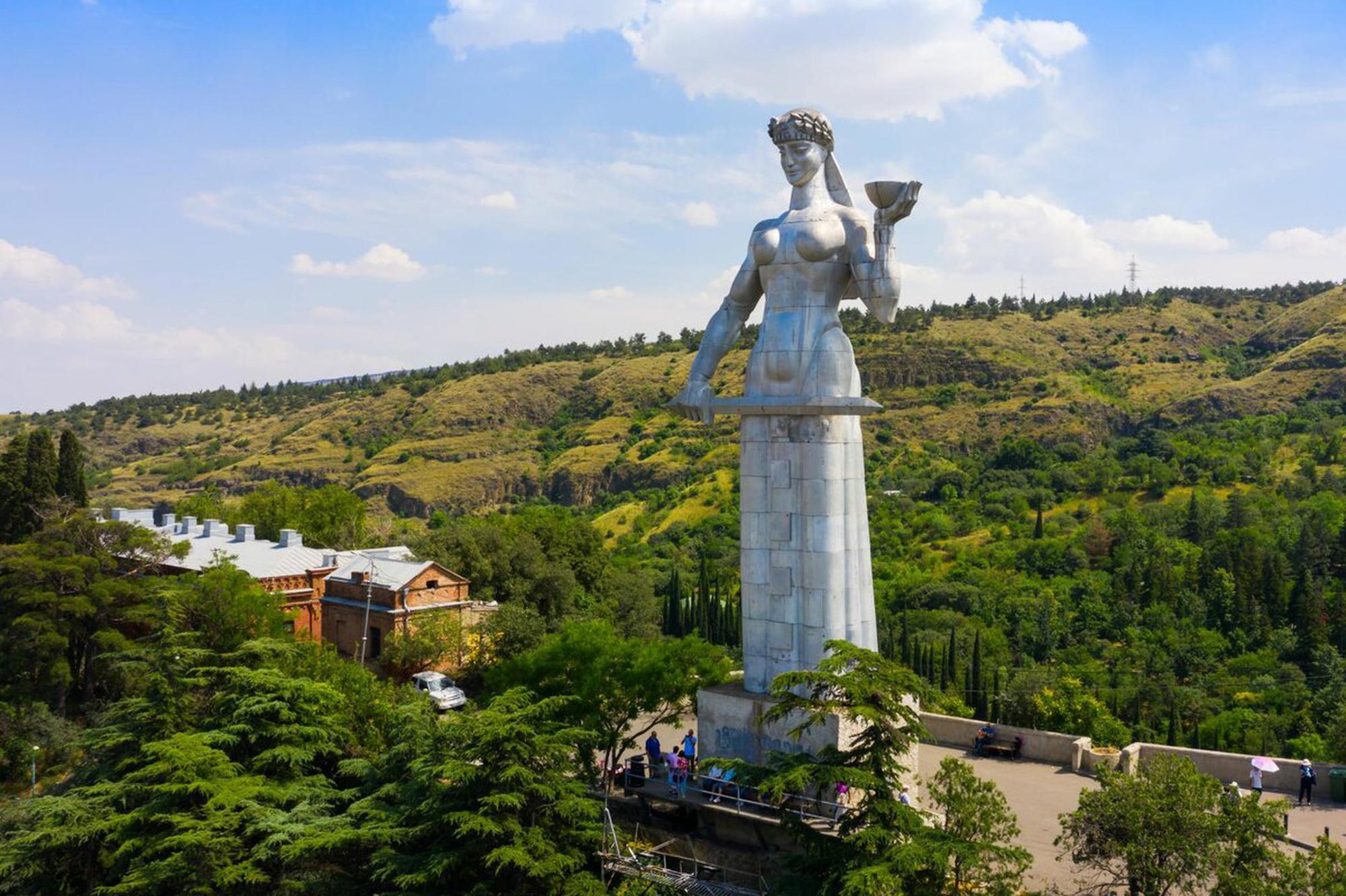
Tennis is elite sport by design and the Hedgehog sapiens definitely is a very interesting beast, which means that in order to belong to our soul health elite in the making, you need to find the fighter hedgehog inside your soul and use it in order not to lose it, just like you would in effect lose an atrophied muscle if just lying idle for a few weeks. Just so the visiting participants know, a large statue (the Georgian version of the Statue of Liberty, let's say), Kartlis Deda (in Georgian: Mother of Georgians), has been erected on a site of countless massacres in Tbilisi in honor of the fighter hedgehogs who fight for their way of life when it matters, are impossible to subdue at spiritual level as a result, and have therefore never been quite conquered, despite the city having been destroyed about every half a century on the average across its long and turbulent history. Which boils down to remarkable spiritual stamina and respectable overall soul health as opposed to the ambitions of all the invaders indeed.
Regarding the urge of the increasingly exposed and troubleshooted power grab "elite", endlessly and tirelessly denigrating capable obstacles to working cover-up like us as conspiracy theorists, misinformation providers, grifters, and other obvious nonsense by now as trust wanes and we relentlessly block their way to de-soul the world that we share, OUR currently popular opinion, in addition to respecting everyone's right to have an opinion, is that we shouldn't waste our time on arguing with stupid people at the level of unprincipled cheap talk, because they drag us to their level of being unprincipled and cheap, and beat us with experience. Better HELP FINANCE A TIMELY INVESTIGATION OF THE BIOWEAPON THREAT by trusted specialists – with a long trail of evidence pointing all the way to staying in respectable soul health – capable of doing it that in turn is well capable of saving your life according to the personal experiences of a growing camp of dissenters next door than listen to the prominent voices of the swamp who try to sell their critique of an adequate warning of a lethal or severely debilitating threat around the corner that managed to make its presence known to the public despite all the cover-up as grifting to the masses of slow-wits they imagine they can catch-n-manipulate in their subscriber lists like a half a million strong school of sillyfish.
As the representatives of the potential of a much different species cooperating in a reality where resources are needed to succeed, let's not get tired of working on our character to keep our soul in good health and build upon it thoughtfully by showing every pretender hedgehog around the potential of the spirit of a respectable human being, starting with tough competitive tennis matches, obviously for everyone with some understanding of where they are coming from worth the effort to strive for. May this somewhat lengthy overview and practical philosophical framework for keeping in good soul health by building our character for a healthy take on our current situations suffice for everyone participating in our Opinion to understand why.
Our singles ranking tournament Kobuleti Opinion 2026 is held from May as soon as at least 3 round-robin groups of at least 4 players each at a similar level of play within each group are ready to participate until the end of the low season for the Kobuleti seaside promenade tennis court community to arrange all the local participants or similar in order of ranking in matches played without a chair umpire.
As long as a sufficient number of participants at a suitable level of play haven't signed up for the event, our Opinion runs in Telegram group mode with none of the tournament stage sections being displayed in the I/O pane of the Tourna-O-Matic widget and the match score pool left unstructured and presented as is after the tournament end date should the participant pool remain too anemic for ordering the participants into round-robin groups and the corresponding match results into stages.
Optionally for the local players having participated in the main part of our Opinion and additionally for accommodating tennis-loving tourists in the Kobuleti rankings, our Opinion is open for more matches in the high season when visitors can compete against those having participated in the low season already who are still in Kobuleti and available for play.
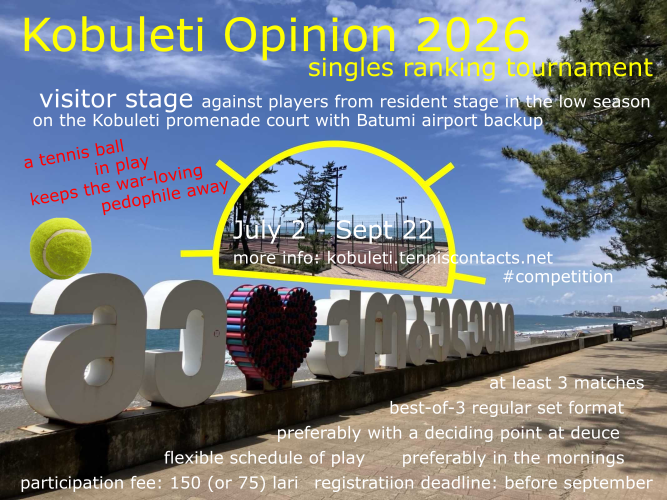
Let's call these tennis-loving communities combined the Hundred Tennis Player Wood community in Kobuleti (we have one in Tallinn for a couple decades already, so we've got a pretty clear idea of what we are doing by now) or the HTPW community for short in the regulations that follow.
We assume you get the idea, too, preferably before signing up. If you don't, exhaustive philosophical insight is available to help you understand why there is a greater need for extinguishing character flaws like hubris, insolence, and intemperance, leading to nefarious scheming like this, than for putting out a blazing fire. Power positions get all too badly corrupted over time.
As an additional quick overview of why we happen to be so keenly aware of this kind of destruction, our system servicing the HTPW communities is known as Tennis Contacts since 2005 when it went public on the Web. Or a few years earlier already when it was used and developed by an accommodating student-led little tennis-loving community on the campus of Tallinn University of Technology, renovating the clay court at the university administration's request for help when the going was tough for alma mater due to the arrogance of the university administration lacking contact with players with adequate know-how and skills. And despite all the talk and even a friendly corruption-breaking contract with those lending a helping hand on clear minimalist terms that explicitly forbade the abuse of authority that had already led to alarmingly visible problems with the university tennis court, the Tallinn Tech administration has actually gotten even worse than what it was decades ago, accompanied by the ever-present misleading cheap talk, in other words hedgehogshit, aimed at suggesting the exact opposite and asking us for troubleshooting.
Helping valuable recreational tennis communities detect and troubleshoot the so-called New World screwworms like the Maltech administration specialized in the undermining of healthy contacts capable of demonstrating the depth of their corruption, and blocking the abuse of capable accommodating university students by utterly corrupt inept parasitic officials hiding behind hypocritical meaningless HS when zoomed in properly, seeking to simply abuse capable students whenever help is needed as a result of such undermining aggressions at corrupt institutions treating students like exploitable slave work force for covering up corruption is the DNA of the Tennis Contacts system and the core of the competence underlying the services it provides. The harsh reality after having responded to a request for help has been spiritually triggering, to put it mild, but let's stop here after a really short overview of where tournaments like our Opinion originate in for a glimpse into the reasons behind its spirit and philosophical setup.
In line with the organizational, philosophical, and technical setup just described at minimum in this quick general overview of the Kobuleti Opinion for the readers short of the time to read it all, please also take notice of at least the kind of participants that our tournament is not accommodating. Other than that you are very welcome to join our community and participate!
On sunny days, matches will be played for free on the Kobuleti seaside promenade tennis court. This court is usually fully booked, so you need to book early to get a chance.
Alternatively, matches can be played in commercial settings on the tennis courts of Georgian Palace Hotel just 5-minute's walk from the Promenade Court.
On rainy days the matches can be played on an indoor tennis court near the Batumi airport in commercial settings if both opponents find it suitable. To get a 10% discount off the court rental fee, 6 consecutive hours or 10 hours within a week need to be booked at once. While it is possible to achieve as a community, the greater challenge here is that during rain the Airport Court tends to be fully booked anyway.
In commercial settings the Tennis Contacts service fee applies, intentionally, which is 20% of the court rental fee. In 2026, however, it won't exceed the discount we get on each respective partner court.
On a sunny day toward the end of the tournament, an outdoor ranking event for the participants who qualify for a place in the top merger group of our Opinion will be held on the courts of the Batumi Boulevard tennis club in a merger group formed with the help of some local opponents at a challenging level of play chosen suitably as a prize for the matches well played against the other participants this year.
The tournament has a flexible schedule and the players arrange for their matches themselves by contacting each other in our ranking tournament Telegram group, specifically created for tournament-related chat and shared with (or at least the intention of the organizer is to share it with) tournament participants only.
During the first 1-2 events of the Kobuleti Opinion, however, we try to be flexible about these and other deadlines, so in 2026 anything described here can be delayed by up to a few months. On the participants' side, please sign up as soon as possible to avoid any further delay of matches. After the first one or two Opinions there should be no lengthy system development delays anymore.
The day of our top merger group ranking event will be chosen about a week before it commences, based on the weather forecast and the players' preferences. With the size of our top merger group being equal to 4 this year, it shouldn't take much more than half a day.
The optional stage of our tournament for visitors is accommodating by design with no fixed sign-up deadline, but in order to find your name in our rankings at the end of the tournament, you need to complete the matches against all the players in your summer league by (not fixed yet and will be published right here as soon as possible, but surely later than September this year).
All matches on the indoor tennis court will be scheduled by the organizer of the tournament, based on input from the opponents on the one hand (please provide plenty of alternatives whenever possible, thanks) and the interests of the court operator on the other. Requests for play on the indoor court (dates and time ranges suitable for play) can be submitted by a personal message to the organizer in in Telegram or using the tournament contact email, and before getting a confirmation in reply in the communication channel chosen please stay accessible for potential adjustments. The cost of any requests for canceling that can't be fulfilled will be covered by the player willing to cancel. The Tennis Contacts service fee will be omitted in such cases, only the rental fee to the court administrator applies.
In any case, please try to never cancel later than 24 hours before the scheduled commercial court usage or later than 8pm on the preceding day, and submit your requests for indoor matches at least a couple days before the desired match along with payment for 1h of court rental, thanks (or more if you think the match could take longer than 2h and you want the court to be guaranteed to be available to complete the match in one go). It is very helpful to let the organizer know about unforeseen circumstances as soon as the canceling of a booking becomes a possibility rather than a reality as this usually allows to reschedule much more conveniently for all the parties involved.
The scheduling of outdoor matches is the responsibility of the respective opponents. Please be mindful of at least the restrictions highlighted in bold font in the regulations of our Opinion while doing so.
A couple reasons for organizing the Kobuleti Opinion have been mentioned already – a more respectable soul health of our societies to drive the abusers of authority out of power (the latter including those using abusive legal coercion methods to make people in Kobuleti commit suicide by jabbing themselves to death just a few years ago, for example, to make it crystal clear what we are talking about here among the rest of the current global mess) and the ranking list for the HTPW community to accommodate more players at a suitable level of soul health and play in the activities of our community easily. Let's not forget about the initial idea, too, of this somewhat belated community tennis event – to celebrate the first anniversary of a public opportunity to play tennis in Kobuleti.
Competing for an adequate place in our ranking list provides an efficient way to get acquainted with players in our community whose level of play matches yours, and managing all of it on the Web makes finding partners for regular training sessions easy. To be honest about the first event of the Kobuleti Opinion, the use of the website of this little tournament as a live demo of systems design and web development skills was part of the motivation of the organizer to come up with something like this to get prepared for applying for a job at this website's hosting provider properly. As long as sufficient interest of the community to participate is there, the organizer can help continue with the IT and the organizational parts of the event annually, but the balls, the rackets, and other equipment need to be provided by the players themselves in addition to respectable soul health or a positive gradient in this direction that has been covered above already. Tennis instruction can be part of organizing our Opinion as long as the location matches Kobuleti and the motivation to give and take is there. In 2026 and early 2027 you can count on this opportunity.
At a spiritually healthy recreational tennis event there is free will to everything both on the participant's and the organizer's side. Which is to say that nobody should feel an obligation to partipate nor troublshoot anyone participating just to deliberately spoil the event for anyone, including the organizers.
In turn we hope that our soul health-oriented take on recreational tennis tournaments during the current times of distortion, confusion, and destruction is a valuable motivation for other communities, tennis-specific or not, unifying people wondering what to do about the currently popular abuses of authority.
In order to make our tournament appealing to fellow recreational tennis players valuing a sound combination of competitive recreational tennis skills and respectable soul health, we can't afford participants with the character of a being who decided that the rules of tennis and those of the more general soul health, implicit in any healthy community of humans capable of operating at a level supportive of matches played without a chair umpire and excessive need for administration, don't apply to them in reality as it would set unacceptable communication style for our entire self-service oriented event. For more information, please see the corresponding entry in the Frequently Asked Questions section outside the scope of tournament regulations.
Regarding a suitable level of play, a basic command of tennis or the willingness to master this level of play within a couple months before participating is enough. In other words – and similarly to the general soul health of those struggling with it – as long as the gradient is positive, we can be tolerant and help. At the other end of the spectrum, NTRP levels beyond 4.5 are a bit too high for our current level of play. That having been said, the sheer willingness to play with a racket and a ball should by and large suffice for a player to be welcome at our Opinion. It is always a privilege to play a stronger opponent after all.
As part of your eligibility, let's say, please submit your match score before leaving the court, if possible, as lingering results can become a major obstacle when scheduling matches, thanks. Likewise, it's not a small deal to play our Opinion matches on Tennis Contacts partner courts only (including just the commercial Airport Court in Batumi so far in addition to the free seaside promenade court in Kobuleti and the commercial ones at Batumi Boulevard for the top merger group ranking event only) as the number of participants we can admit depends on the success of our cooperation with commercial tennis court managers that tends to be proportional to our booking volume. And of course, canceling one's match repeatedly during the same tournament, not showing up for a match one has invited an opponent to play, and so forth are all signs of not being eligible to participate in an otherwise reliable community of tennis partners.
The max number of players our tournament can accommodate depends on the number of courts available to us that the participants are actually willing to use. The rule of thumb is that the participants of our Opinion want to play their matches in Kobuleti but not pay for the court. As we only have access to one such court – the Kobuleti seaside promenade court – where this requirement can be met, the max number of participants we can admit depends on the number of tournament matches the community of recreational tennis players using the Promenade court are willing to accommodate. We found this number to be one match every other day on the average in the warmer halves of 2026 and 2027, which translates to max 4 round-robin groups of 4 players each + up to a total of 2 extra players in the non-middle groups in the first 3 months of the tournament (4*6+3*4+2*4= 44 < 90/2) and realistically just 1-4 concurrently participating tourists in the high season, i.e. a match every other day or once a week max, respectively, depending on the length of their stay and their frequency of play, which translates into 11 participating tourists max and a total of 29 participants max per season should all the matches be played on the free court.
The Airport Court is far away and has a good fill rate already, so it can't change the big picture and by and large provides just an option for the rainy days to get a few more matches done. If our Opinion becomes popular with the local players during the first couple years this event takes place in Kobuleti, however, then perhaps our Opinion will be given more space on the Promenade court by the sheer will to participate themselves or maybe even build more tennis courts in Kobuleti as a result. Until then the only realistic way we can extend our Opinion is by using the 2 artificial grass/sand combo courts at the nearby Georgia Palace Hotel (located just a few minute's walk from the Promenade court) that cost 50 lari/h in 2026. Considering their extremely poor fill rate, we could easily scale our Opinion to a hundred participants by accommodating paying participants (those beyond the first 29 to sign up for our Opinion) who play all their matches at GPH if they pay for the entire court, not just their share of it unless the opponent shows initiative (without being pushed in any way) to pay half the rent themselves.
One more unusual eligibility restriction applies. We start the draw with at least a dozen seeded players who we know are eager to participate. The level of play of any additional participants must make sense to the seeded players for any changes in the initial draw to be introduced. Consequently, the eligibility of players whose level of play is within the above described helper restrictions is very likely but not guaranteed, which applies especially to players at NTRP levels way below 2.0 and not improving as well as those way above 4.0 this time if our top round-robin group is getting just a little bit overcrowded (so an additional group can't be formed) for our top players' time available for tennis this summer.
Our Opinion 2026 is focused on our character and all the soul health that depends on it, and will continue to be so should there be any future events of this tournament. Which is to say that at the end of the day players who don't have respect for the Fair Play principle are not, of course, welcome to take part in any tennis tournaments played without a chair umpire nor any other community events where mutual trust is critical for a successful outcome, and our Hundred Tennis Player Wood communities' tournaments are no exception to this rule. For example, repeatedly disturbing the rhythm of play by excessive disputes and other ways of playing the fool on court are not part of Fair Play, in addition to the more traditional ways of "playing" tennis without a racket and a ball for an unfair advantage when the going is tough.
We are experienced enough to be willing to solve any potential problems with someone's soul health in our communities without a waste of time and not willing to offer excessive pointless opportunities for someone's destructive efforts, who is reckless enough to not fit in a friendly respectable community, to just sow harm on our motivation to organize and participate, be it the urge to cover up one's lousy soul health instead of being constructive and trying to improve one's character or whatever else might happen to be ailing a slow-wit asking for troubleshooting – simple as that. The organizing committee, of course, will try to do their best to keep such problems out of our communities early on, but sometimes an unforeseen bug can creep in and then some community support might be needed to fix it together in the most pleasant way possible for everybody, thanks.
The confusion and abuse in our current reality that the equivalent of Little Hedgehog arranging for a match can turn our cultural differences into can make some participants lose their motivation to continue participating in our Opinion, as we have already witnessed and need to update the regulations accordingly. In effect, dropping out of the tournament like that is not Fair Play, and as a result, abusive cultural domineering is something that we would really like to avoid at our Opinion as we explicitly welcome everyone in the Kobuleti tennis-loving community pursuing respectable soul health at our Opinion instead, regardless of their nationality or any other naturally given.
For example, there are peoples like the Russians and the Turks who seem to have it in their social upbringing on the average to go right down the rabbit hole as soon as a provocateur arrives. On the other hand, there are peoples who usually don't, such as the Estonians and the Georgians, for example, as time is valuable and there are other ways of holding the provocateurs in contempt, which sometimes work more efficiently and sometimes not. In general, the Hedgehog sapiens seems to be notably abusive of position, especially power positions, so making one's opponent confront a rabbit hole as a result of abusing the position of being their opponent in an upcoming match isn't new at our Opinion either nor in the longer run the way one fits in a community optimized for everyone willing to just play, become a better player in the process, and behave to make it possible for everyone willing to participate.
To help guarantee pre-match Fair Play in the motivation territory for competing in a community of fighter hedgehogs in respectable soul health, the tournament regulations now provide every participant with an abuse rejection toolkit for rejecting the offer to go down the rabbit hole, helping keep our Opinion provocateur-free, and helping prevent sagas like some of those on the pro tour from gathering momentum at our Opinion where we play tennis without a chair umpire, with the racket and the ball, and not with something like a highly vocal vocabulary after a 7-minute toilet break for getting between the ears of your opponent in what's about to follow. Every participant can choose to use this abuse rejection toolkit or not, as they deemadequate personally or according to their cultural preferences.
The toolkit can be thought of as a set of useful functional tips from the organizing committee to a) arrange for matches against unknown opponents and known unfriendly language specialists of the locker room in the tournament Telegram chat instead of doing it privately as if with players you already mix well with; b) use second-person plural instead of singular in languages unlike English to explicitly show respect so your opponent knows you are respectful even if you mess up arranging for your match unintentionally; and c) in case of a communication deadlock or similar you can't recover from on your own, please send a notification to the main organizer of the tournament to take over the communication if he hasn't noticed himself already that there is someone monkeying in the chat (as opposed to "a monkey in the chat", because to err is human, sometimes unintentional acts may be misunderstood as intentional, and assuming that guilty are the actions of the people involved rather than the people themselves usually helps find a good overall solution, thanks). This way we can detect the need for either a substitute player or in complex cases a competing branch of the round-robin group where at least 2 players have already got stuck with arranging for their matches and are not enjoying the tournament anymore.
In the latter, more complex case, these 2 players can play each other and invite others in the original round-robin group or new players at a suitable level of play whom they would like to compete against to join their competing branch of the group. If they manage to complete the matches in the competing branch sooner than in the main branch then the new branch is merged into the main flow of the tournament instead of the original round-robin group, and the players not invited over may be left on their own to use communication skills of their own to find substitutes for the missing players to be able to complete the 1st round of the tournament and be just a click away from the main ranking list. Failing to do so would result in not being present in the final rankings, which means not being seeded in the initial draw the next time our Opinion takes place. It will probably take years to get the garbage out of our chat so our Opinion can run smoothly, but according to our experience, it surely is worth it, so the organizing committe needs your help to keep an open mind (as opposed to ending up sending screenshots of private messaging) and not leave a chance for the unsuitable players for our community to abuse our privacy, which would result in quite the opposite of our Opinion being in good soul health and a likely loss of participants who should be enjoying competitive matches against us instead. Creative fighter hedgehogs like the ones participating in our Opinion can surely cleanse the communication ether of our tournament of shit like this.
This way the participants themselves can shape our tournament for the better. The tournament committee can create a competing branch only on the basis of clear evidence of someone making their opponent face a rabbit hole or similar. That's why the committee's recommendation is to use the general Telegram chat of our Opinion instead of private chat for the arrangement of matches. The tournament committee doesn't pick any cultural sides; we just want our tournament to be fun for everyone pursuing respectable soul health. Those with less than 3 matches played can choose to get their participation fee back.
Our current experience clearly shows that without proper security there would soon be no Opinion.
We contribute to a healthy environment and our continued opportunity for participating in recreational tennis activities like the Kobuleti Opinion by means of a 15-minute jitter of the start of matches that helps block the abusive habits offered by the DEI/stakeholderism kind of a Nazi regime currently lurking around the corner from taking root. It doesn't mean that our Opinion encourages being late for your matches and keep your opponent waiting, but whenever you find a max 15-minute delay necessary for the completion of whatever you are doing prior to the match that is more important than being there on time with the precision of a totalitarian soldier of the 1984 stripe, we understand that our recreational encounters might not be as important, and thus the corresponding delays within the so-called academic quarter by at least the tournament committee would not be frowned upon.
We hope this concession helps everybody relax and it will be used only when really needed and adequate. After all, it is important not to lose our sense of proportion and have a handy means of keeping any potential abusers of our procedural memory out of business, so let's train it once in a while and get something truly helpful done in the process as some important tasks can be time-critical and little hedgehogs can easily become all too abusive without due reminders...
The participation fee at the resident stage of the tournament in the low season is 15 lari or 5 euro, depending on the payment method, added to which is the court repair fee, so at resident stage the total participation fee is 35 lari or 11 euro, respectively. No other fees are required, except if willing to play some matches in commercial settings, because the usual hospitality of the Georgian people is well worth the nearly free offer to participate.
The participation fee at visitor stage in the high season is a zero higher, i.e. 50 euro or 150 lari (with no court repair fee added, of course). For tourists from countries where 50 EUR is too much for a tennis tournament participation fee, let the participation fee be 25 EUR. The first tourists to paticipate might even get an opportunity to fill an opening in our initial draw at a scarce level of play and participate at the resident stage at the corresponding price. Thanks a lot for your help making this event possible this year!
The payment methods available at resident stage are 35 lari in cash on court, 35 lari transfer to Bank of Georgia, and 11 euro transfer using Stripe. at resident stage. The latter amount can be more if you want to donate to support soul health projects like the Kobuleti Opinion on the free public tennis court of a beautiful Black Sea resort, Tennis Contacts in a few countries already, Keeping You Honest on Substack, or Stop Maltech running on a custom presentation framework at Hostinger. The last 2 payment methods can be used for paying the Tennis Contacts commercial branch service fee when playing in commercial settings, too. At visitor stage the same payment channels can be used at the visitor stage price.
Our money-back guarantee expires after 3 matches. To be able to continue after having completed these, one must pay the participation fee. The court repair fee is not refundable after the first match on the Kobuleti seaside promenade tennis court.
In 2026 the rental of the so-called Airport Court costs 55 lari/h and our discount there is 5 lari/h. In commercial settings the Tennis Contacts commercial branch logic and the TC service fee applies, which is 20% of the court rental fee paid by the opponents to the organizer of the tournament using one of the payment methods described above, so in 2026 it is 11 lari/h (5 lari/h from each singles opponent, let's say).
There is no fixed limit for the discount that can be asked from commercial tennis court owners, but life in commercial settings shows that these discounts need to be earned by the booking volume at times of interest for the court owners as well as otherwise nice and smooth cooperation. Let's try to double the discount for our next event there!
The organizer's experience in Estonia since 2011 shows that discount from 10-50% is realistic over time, depending on the location and fill rate of the tennis courts being booked.
The Airport Court is booked for tournament matches by the organizer of the tournament only. It can be difficult to find for tourists visiting Batumi for the first time, so here are the instructions for those of you not quite sure of how to get there:

The closest you can get to the Airport Court by public transportation is less than half a km from the southern corner of the Batumi airport down the street (and to the left for the last hundred m or so) that starts at that corner where you can get by minibus #20 which leaves from the square in Batumi where the minibuses to Tbilisi leave from, about 200m from the cable car station down the Chavchavadze street. As the cable car station is also the final stop for the minibuses coming from Kobuleti, minibus #20 provides a convenient way of getting to the Airport Court for 1 lari every 12 minutes from 7.30am to 9.30pm in the 2026 season.
Thanks a lot to everyone who decides to support the organizer's work this way!
Combining public and commercial courts when organizing a tennis tournament can easily get tricky because of the problems that come with someone's fee in public space. Among potential other reasons, such a fee greatly helps against quite a few people not very interested in tennis or the concept of Fair Play, to be honest, looking for silly fun in the wrong place, which can easily get intolerable for participants in the role of a tournament organizer but also a regular opponent having to deal with all the annoying creativity of the Hedgehog sapiens on court up to a non-zero threshold of a reasonable participation fee in reality to filter out excessive free headache for everybody willing to just participate in a recreational tennis event.
Provoking scenes like the one above for someone's stupid "joy" in recreational tennis matches played without a chair umpire is not welcome at our Opinion, thanks! The organizing committee doesn't know of a better working solution in reality than a minimal participation fee to keep the recklessness or abusive intent behind provoking such intolerable conversational overhead out of our tournament or at least within bearable confines, so if you know of any more advanced means to keep such troublemakers off tennis courts then please email your advice to us for consideration. But what does such a little blocker fee have to do with challenges on municipal premises?
Turns out that making money on a municipal tennis court in Kobuleti among many other regions is forbidden by law. The law, in turn, must reflect the will of the local people who might be willing to make exceptions, depending on how well the tournament being organized in our case meets their expectations. And these expectations can vary greatly between those of the people interested in participating in the tournament and those willing to use the court for regular practices only.
Therefore we can easily end up with ideal conditions for a divide-and-conquer just waiting to be triggered by people in poor soul health on the regular practice supporter camp whenever someone shows up on court without sufficient respect for the opportunities of local people to play on THEIR court being used for OUR tournament. To sum up the details of the situation in Kobuleti and how we can deal with it, for example, there have been clashes already between local people and visitors from a certain neighboring civilivation, let's say, occupying the court for half a day in a row, so the mood of local people is not very favorable for a tournament to be held currently. What we can do in this delicate situation is to make a gesture that we are reading the situation carefully with respect for the local people's opportunities to play, and then let's see what happens.
Such an opportunity for a friendly gesture and a practical solution to the problem situation created by a lack of considerateness of a third party can be found in the condition of the court we are using for our tennis activities, be these activities of interest to the guys on the regular practice supporter camp or the tournament match player camp of the local tennis enthusiasts in the first place. Being close to the sea and open for acts of vandalism, the court already needs to be resurfaced, its gate needs repair, the poorly designed fence needs a fix for balls not to escape and fall prey to the numerous dog spectators around, very eager not to give the ball back, and so forth. The Kobuleti Central Park administration will provide the lighting of the court, but pretty much all the rest needs to be provided by the players themselves, which a couple upset local people on the regular practice supporter camp who already keep jumping at those providing instruction to tournament participants well within the limits accepted by the community haven't paid attention to so far. Let's not be petty on our side but show some friendly constructive initiative by donating 20 lari from each tournament participant to finance the three most urgent court fixes listed as well as do the repair, thereby expressing our willingness in reality to contribute to the welfare of the court we are using for our tournament matches, which those not participating can also benefit from, and improving the overall soul health on court in the process as a role model for the pushers of the above mentioned, say, cowboy conflict introducing conflict "solving" initiative to catch up with.
Due to the nature of the situation just desribed, we should pay additional attention to respecting the usual 10-minute warm-up time before matches when playing on the Kobuleti public court. Those of us who want to warm up longer than that can do so courtside earlier. Also, we can increase our scheduling certainty considerably by using a deciding point at deuce. And with the help of the local people on the tournament match camp we can make a fairly logical assumption that those lazy enough to book the court before coming to play are sleeping long enough in the morning to let us complete our matches until noon every day. With a deciding point in each game, that will probably guarantee any match started at 9am or earlier to be completed in one go. And other tournament participants are encouraged to provide help with getting each other's matches played without interruption by booking the court until noon for regular practice sessions, thus providing a buffer for a deciding set to be played whenever needed. After noon our tournament matches can't last longer than one set (no more than 1.5 hours, that is) if anyone unwilling to use the booking system is waiting courtside for the court to become available.
In case a gang of local people, who haven't quite understood the benefits of our tournament for the local people and potentially for their entire country, shows up on court after noon to evict you in the middle of a match that has lasted for less than 2 hours, you can call a local assistant referee Mamuka who would like to talk to these local people about the advantages of our tournament for local people and ask them to upgrade their software as far as the local guys willing to participate in our tournament are concerned. Let's support this substantial challenge to avoid any further clashes by not booking the Kobuleti public court for tournament matches more than once a day, except when booking after 8pm on the day before the match, thanks. Also importantly, let's play in the morning, preferably, and book the court for the entire match. Or book it for max 1.5h (just one set) if playing after noon. To sum it up, in case you can't make it in the morning, be prepared to have your match interrupted by those sitting courtside in 2 hours (or right after the set if playing after noon), or play on the indoor tennis court near Batumi Airport instead, thanks.
On the positive side and to the absolutely due credit of the local slow-wits, however, it can't be left without mention that the opinion of the Georgian local guys is an excellent reminder for the local guys of certain other satellite regions of the former Soviet empire that abusing power positions even passively by letting steal from each other or just sell everything for shallow profit as a society, which has increasingly become a fashion and a telling consequence of the predominant prostitute mentality governing the slaves of the "new" alternative empire pretending to be different from the previous one, is not a wise choice for a nation determined to stay independent and free. In other words, the cultural evolution and depth of a nation is not a small deal.
The tournament is led by a head referee who is guided by tournament regulations and whose decision is final. An assistant referee is there to help with disagreements, but ideally the role of both referees is zero. consists of the head referee and (main) organizer Andres and the assistant referee and assistant organizer Mamuka.
The main communication channel of the Kobuleti Opinion 2026 is our ranking tournament Telegram group where all the participants and the organizing committee of the tournament can be contacted.
At the Kobuleti Opinion 2026 the ITF rules of tennis 2026 apply, combined with the procedures for matches played without a chair umpire by Tennis Australia. As the Kobuleti Opinion tournament events are considered part of tennis instruction, all tournament info will be available at the Tennis Contacts Kobuleti educational website kobuleti.tenniscontacts.net.
All matches will be played in regular best-of-3 sets, meaning that in order to win a match, one needs to win 2 sets, each set ending in a deciding tie-break whenever the score is 6-6. The tiebreakers are played to 7 points with a minimum point difference of 2 points. Unlike the tie-breaks and due to the Kobuleti public court being overcrowded, we use a deciding point at 40-40 in all matches, preferably, including the ones played outside Kobuleti.
The overall architecture of the tournament is optimized for getting all participants sorted in an adequate ranking list by the end of the season in a reasonable number of matches per participant. Which is to say that we start with round-robin groups of 4, but depending on feedback from participants we can increase the number of players in round-robin groups to 6 or even a larger even number, depending on how many courts we can book easily and how much time for tennis we have at our disposal. If just one of the players doesn't find the increase of their group size comfortable enough, this increase gets vetoed, except for the minimal increase of the initial size of some groups to accommodate as many of those willing to participate before the tournament commences as possible within the initial group size + 1 restriction for the lateral round-robin groups and one more for the middle ones.
Play during our ranking tournament is conducted in 2 stages with an optional 3rd stage. At 1st stage, the seeded players and the players that can be added suitably for all the seeded ones are grouped into round-robin groups where they play against every player in their group. Before the 2nd stage, the top half on each round-robin group having an adjacent group of a higher level of play is merged into a merger group together with the lower half of the higher-level round-robin group. Second-stage matches can be played against anyone in the adjacent round-robin groups in order to accelerate the scheduling of tournament matches or just for playing extra matches against interesting opponents for fun to further hone one's tennis skills as long as both opponents find it motivating enough, so the results of some of these extra matches may end up being redundant. The round-robin and merger stages of our Opinion are designed for local people, but any visitors staying in Kobuleti early and long enough are welcome to participate at these stages, too.
The top merger group deserves special attention as these are the strongest players among us who might need extra motivation to participate next year, so a separate ranking event will be organized in Poti, involving carefully selected local players at a challenging level of play for our prize matches. By default the matches of our top merger group ranking event will be played between the upper half of the 1st round-robin group of the resident stage and an equal number of players from Poti only. However, if any visitors ranked in our top summer league would like to participate in our masters event then we can ask the players in Poti whether they would like to play more on the day of our masters event or on another day. The rest of such extra matches can be played in Kobuleti.
The optional 3rd stage of our Opinion is designed for the tourists visiting Kobuleti in the high season, but any resident players, especially the unseeded ones whose level of play didn't fit in the earlier draw, are welcome to join us at visitor stage, which implies a participation fee of a higher order of magnitude but is probably better than nothing for at least some of those not having been able to join us earlier to get seeded in round-robin groups. Our 3rd stage groups are the final international of the Kobuleti Opinion, and in such Opinion leagues each visitor or similar gets to play everyone in the merger group that best matches their level of play.
Similarly to determining the level of play of a new local participant before the tournament commences, to determine the appropriate summer league for a visitor, a test set against tournament organizers or other players at a known level of play will be played, and to qualify in the selected summer league, at least one set against one of the lowest ranked players in this group must be won. Visitors, too, are welcome to play opponents in all our summer leagues if they like, but only match results against the resident stage players in their summer league, or substitutes in the higher adjacent resident summer league (as close in ranking to their summer league as possible) if not every resident stage player in their summer league can participate at visitor stage, will determine their place in the final ranking list. Visitors ranked equally as a result will either share a ranking cluster or play out all the rankings in it if everyone sharing such a cluster is available for play simultaneously.
The calculation of one's ranking in any group or cluster is based on the number of wins, the number of sets won, and the number of games won in one's round-robin group, summer league, international summer league, or visitor shared ranking breaker group, in that order. In the extremely rare case of a tie after applying these 3 tests, the order of the parties involved in the final ranking list will be drawn based on the earliest of them to submit their last result during the tournament as a thank-you for a contribution to speeding up the scheduling of matches. Incomplete matches will be accounted for at visitor stage only with weight 0.5 for winning the first set if the second set was not completed.
To keep it simple, we try to keep the size of all the round-robin groups between the first and the last one the same or at least avoid an odd number of players in the middle round-robin groups. If that's not possible then half of the size of the smallest even-numbered middle group at round-robin stage is equated to the number of players added from the pair of its higher and lower adjacent round-robin groups to form the respective groups for the merger stage of the tournament.
To help with all the calculations that events like the Kobuleti Opinion 2026 in the Tennis Contacts system depend on, the storage of match results, the display of these results as well as information about the upcoming matches, and other reasonable conveniences that imply automation, the system has a web interface for doing all the I/O needed to delegate these routine and often tedious tasks to a computer.
To use the Tennis Contacts system online for submitting your match results at our Opinion, you need to log in to the Tourna-O-Matic widget of the kobuleti.tenniscontacts.net website.
Match scores may be submitted by one or both players. Please use the I/O tab of the Tourna-O-Matic widget to do so. If both players submit the score and these scores differ with neither of them or both having been confirmed by the opponent then the one entered first will be declared to be the official result with an indicator attached that a cron job was needed to determine the result a week after the first entry of the score or when the tournament ends. If only one opponent enters the score then the cron job will confirm the result similarly, but without anything attached. Please enter the score on the same day, preferably immediately after the match ends to avoid getting into trouble remembering the correct score.
When submitting the score of a match fully or partly played on a commercial court, you need to specify the duration of court usage (or the part of it ending up in commercial settings if the match was partly played on a public court) which has to match the ACTUAL time spent on court that corresponds to the amount paid to the court administrator, not the initial booking length if the match turned out to be longer than initially planned. The shortening of match length in terms of the amount due to the administrator is not an option during our first Opinion, so if your match ends sooner than predicted, please use up the time left for regular play. The plan for the future though is to get permission during the unpopular parts of the day to be able to shorten match bookings on the go if the match ends sooner than the booking and the fill rate during that part of the day happens to be favorable of it. All our matches are intended to be completed in one go whenever possible. And according to the overall spirituality of our Opinion, each participant is expected to try to complete all matches and avoid any walkovers. If the latter happens then their weight will be half of that of a normal win. If matches can't be completed due to injury then the organizer will try to find a substitute. If this doesn't work out then the results of the matches against the withdrawing participant stand; otherwise, all matches against the withdrawer will be replayed against the substitute.
To keep the participation fee of at least the resident stage of the Kobuleti Opinion as low as possible, the kobuleti.tenniscontacts.net website uses the Shared Hosting Plan at Hostinger. Which is to say that some of you might be exposed to the quirks of the Hostinger shared hosting firewall, so here comes some tech support to work around a typical situation in case you happen to have an IP address that the firewall mysteriously perceives as being abusive and blocks you from accessing the kobuleti.tenniscontacts.net website. Usually such downtimes aren't frequent and are transient in nature, probably getting solved without any intervention in an hour already. If the problem persists, however, the easiest way of restoring access is by changing your IP, most probably, so let's give some practical advice for those in need how to do it.
The quickest way of changing your IP is to change the device you use to browse the kobuleti.tenniscontacts.net website. If this isn't possible and you are using mobile data on a smartphone then you can change the IP address by trying to access the website with airplane mode on and after it fails switch it back on and try again. Alternatively, you can email your IP to Tennis Contacts Support with a short description of the problem or try to unlist your IP from the Hostinger firewall on your own by clicking on "Agent" in the top navigation bar of the Hostinger website to submit a request along the lines of "Hello Kodee! My current IP address is *.*.*.*, its Confidence of Abuse score at AbuseIPDB is *%, and I am apparently blocked from accessing the site kobuleti.tenniscontacts.net at Hostinger. Please unlist my IP from the Hostinger firewall as I am actually not being abusive in any way, thanks!" after replacing all the 5 asterisks with accurate numeric values to get your blocked IP unlisted if your AbuseIPDB score is 0–15%. Hope this helps if needed.
Whenever the Tourna-O-Matic widget can't be used for entering a score, please use our ranking tournament Telegram group to let the organizers and other participants know about the result until the system can be used again to enter the score normally.
For your convenience, the TC authentication uses the Telegram login widget, so in order to log in to the Tennis Contacts application, you need a Telegram username. As our tournament uses Telegram as the main channel for all tournament-related chat, you need to sign up for Telegram anyway.
Oh yeah, Facebook is the worst – when the largest wave of abuse of global authority so far broke out in early 2020 in Europe, the FB dev team swiftly got in the severely totalitarian habit of trying to extort code from developers willing to use Facebook Login to determine whether they were eligible for their widget in their applications or not. Well, that kind of "fun" resulted immediately in Facebook Login being removed from the Tennis Contacts login options, obviously, with advice to all TC users to be wise and not use Facebook anymore if possible.
The all-too-busy slow-wits may want to read a 1-minute summary of the reasons why we need to change course before it is too late. And regarding the FB dev team, well, what a nasty stupid gang of treacherous bootlickers who don't deserve any position in software engineering at all, let alone on such global administrative scale!
If you have participated in Tennis Contacts events before and consider our traditional login method from the days of the Horde framework secure and convenient enough then you can skip the rest of this section and continue with the sign-up procedure for our looong summer tournament in Kobuleti this year.
If you are a Telegram user without a username then please create one. If you haven't used Telegram before then you need to copy the following information from Telegram to Tennis Contacts: 1) your Telegram username; 2) your first name in full; and 3) at least the first letter of your surname. Your name will normally be displayed in Tennis Contacts in the format FirstName L.sha, where L is the first letter of your surname and sha is the first 3 characters of the SHA-256 hash of your Telegram username, but for specific actions like letting the system generate a diploma you have the option of using your full name if you have provided it in the system. In summary, you are not required to provide any more information about yourself in Tennis Contacts than the minimalist details listed above for the presentation purposes of all the results from matches played in the Tennis Contacts system.
Whenever you would like to participate in our events and for some reason your Telegram login doesn't work, you can use the TC login until you get acces to your Telegram account again, provided that you have set up a Tennis Contacts login as a result of registering for our Opinion, for example.
After you have signed up for Telegram properly, you are ready to log in to Tennis Contacts and sign up for any events of our HTPW communities.
This is how you sign up for the Kobuleti Opinion singles ranking tournament:
Our ranking tournament Telegram group is for participants only and won't be revealed here.
The result of our ranking tournament is a ranking list. This list is the basis for determining round-robin groups the next time a ranking tournament is held should the interest of the participants still be there.
If someone is injured or feels they are playing well below their last year's level of play then their ranking can be decreased upon request, but an increase can be earned by participating in our ranking tournament only. Likewise, when assessing the level of new players, the organizer is inclined to give them a slightly lower ranking to start with.
Group borders can be drawn any way, but the objective is as even a level of play as possible within each group as well as a reasonable number of matches per participant. The latter is determined by the organizer by posting a draft initial draw to our ranking tournament Telegram group before registration deadline to let all the potential participants veto a too small or large group size. A reasonable effort is made to try to not leave anyone in the draft initial draw out of the round-robin groups due to inconvenient group size, but if this happens then they can participate in the optional stage and still get a place in our ranking list.
No tangible prizes are intended for the top-ranked players at the end of our tournament, but a helpful ranking list for finding opponents at a suitable level of play and a valuable opportunity to brush up one's tennis skills by playing against a variety of opponents at a suitably challenging level of play should satisfy those for whom events like this are organized in the first place. As an additional motivation for our top-ranked players to participate next time, we'll look into opportunities available for coming up with a few prize matches at a challenging level of play toward the end of the season.
To sum it up, we keep our focus on the importance of the invisible right to the end of our singles rankings Opinion.
Your participation in the activities of a tennis-loving community like the Kobuleti Opinion 2026 draw of recreational tennis players provides a little but important bit of soul health insurance for your society as competitive play in a recreational tennis community, chosen with integrity, can only improve it.
Our societies need leadership at this level of soul health to remain or become as soul health-protective as they should, so may there be many more communities like ours around, do so early, and at the end of the day, may a tennis ball in play keep the war-loving pedophile away. As you've probably figured out by now, for this proverb upgrade to play out on time, you need to participate early.
See you early, fighter hedgehog, and good luck with your homework challenge after a soul health-protective summer of as highly competitive tennis battles as our community can currently provide!
The Kobuleti Opinion 2026 tournament organizing committee
➤ Back to sign-up checklist
Andres: To be honest, tennis can't be played at all when one or more opponents don't respect the rules of tennis and there is no chair umpire around, unlike in the tournaments on the pro tour. Likewise, when one or more participants don't have respect for the overall soul health of the tournament, the organizers alone can't make the event appealing to valuable opponents capable of improving our spiritual stamina by competing against us in a way that makes sense in the sport of tennis. For anyone committed to the Fair Play principle and willing to cooperate in keeping our tournament in good soul health, however, the "Opinion" part of the name of our tournament becomes a synonym for "Open" automagically.
Opinion, on the other hand, doesn't cause a linguistic nonsense like U.S. Open or Australian Open 2022 when used in the name of our tournament. Furthermore, the word "opinion" in the title also provides linguistic support and vitality for keeping in good soul health as according to the regulations of our Opinion and the logic of the corresponding reality there is responsibility involved that motivates the participants to try to keep in respectable soul health for the purposes of our tournament per se. That's why we EXPLICITLY FOCUS ON having just PERSONAL OPINIONS – how something sensitive relates to us personally, giving respect and expecting respect, i.e. without any absolute evaluations of someone's worthiness, despite everything (watch from 11.25-15.6 to skip some introductory mess in my opinion). It's about keeping our tournament in good soul health and open in an honest way, basically. The language we use is crucial in turbulent times when war refugees from both sides meet on court, so we need this tournament set up properly to remind us that our opinions are like assholes – everybody's got one. And we shouldn't generalize them recklessly as if the soul health of our Opinion didn't matter more than that of any other tournament being organized out there.
That's the short answer, but let's dig deeper as our reality tends to be complex enough for us to fail in paying attention to what absolutely shouldn't go ignored. Let's use the work of a few fellow authors on Substack, to do it concisely, whom I cooperate with to find out how to resist the abuse of authority and drive those practicing it out of power most efficiently. I became keenly aware of the problem of the abuse of authority as the administration of the Tallinn Tech tennis court was brutally hijacked from me in 2019 along with an apparent bioweapon attack on my lungs that left my health in a near-fatal state (and me incapable of any efficient self-defense, of course) for very many years, starting right before the global brutal vaccination abuse campaign, probably designed to cover up such crimes more easily. I am making the latter statement with a substantial level of confidence as our university was hit by an entire wave of the brutal canceling of people – whom our university owes A LOT of gratitude, interestingly – on the basis of disobedience to the regime established with the help of, say, the intellectually trojan present of computer parks from Microsoft for those of us refusing economically powered ideological tyranny known as the DEI/stakeholderism combo that in reality mandates following intellectually demeaning, unjust, and even plain and simple criminal orders such as signature blackmail, for example, coming down the university's chain of command and covered up by silencing efforts similar to bombing an enemy to the Stone Age for the political "fun" of the current international practices of a collapsing empire with a shallow cultural background.
So, what does the counter-canceling of such barbarians have to do with our respect for the rules of tennis and the overall soul health of our singles ranking tournament to keep the name of our singles ranking tournament synonymous to Kobuleti Open? It has to do with keeping our language explicitly free from distortions in the current era of distortion, confusion, and destruction in the first place, thus avoiding the shallow culture imposed on us by woke barbarians and the destruction that comes with it, and then explicitly focusing on maintaining a respectable overall soul health as a common denominator. My counter-canceling idea is that once we have filtered out and blocked the shallow or outright abusive kind of intent at cultural level, which some members of our healthy leadership-capable elite have clearly enough pointed out as the way to keep our societies out of trouble, someone's personal rot of character or that of an entire cabal of brothers-in-crime can't result in the abuse of our societies and the accompanying inevitability of collapse anymore, known as the parasitic elite overpopulation. The question is, can we filter such abuse out of our societies?
With the help of establishing sound principles of communication, I believe that we can. Also importantly and referring to the processes usually accompanying the eviction of such rot, we'd better make sure early on that in a logical sequence of events our tennis courts among other valuable ground for making good use of our lives aren't turned into battlegrounds for very non-tennis purposes by cabals of, say, war-loving pedophiles. Tennis is a healthy kind of elite sport by design, meaning that it encourages both the financially motivated professional and the sometimes more open-minded recreational players to take responsibility for acting with integrity rather than think about the prestige that comes with fulfilling these responsibilities properly, let alone brag about it like a zero-wit power addict, so we should make more use of what this sport has to offer to those capable of healthy leadership in our obvious current global leadership crisis in the extreme capitalist camp oiling their War Machine in increasingly fancy ways for the last decade or so. I am not saying the extreme communist camp is any better, but somehow they really don't seem to have the floor for quite a while already.
There is on more point that needs to be made here as far as the non-negligible danger of our tennis courts being turned into real battlegrounds in a logical sequence of events these days is concerned, although this isn't directly my reply to your question. Well, it may sound way too far-fetched normally, but on the positive side against the backdrop of all the narcissistic war-loving pedophiles lacking basic competence and driving our international politics right into absolutely pointless wars doomed to be lost currently, they have inadvertently fetched it close to breaking through to our critical masses of slow-wits by now how important in our life the art of losing actually is. I feel that any respectable tennis tournament should currently capitalize on this miscalculation of the war-loving cabal and explicitly focus on contributing to the art and competence of losing.
Referring to your test set against Georgy for a place in our top round-robin group, the minors among the participants of our tournament are our future, so we should take the time to explain why it is so important to learn to lose in a certain manner. Here is a poignant entry in my own Substack note flow to provide some guidelines for your convenience along with a six-pack of known as the secrets of Spanish tennis to educate our up-and-coming healthy leadership-capable elite to become respectable players, no matter what the outcome of one match or another against a solid opponent. We don't want any idiots in power positions, alright, resulting in our tennis battlegrounds being turned into real battlegrounds, so we stick to a racket and a ball by teaching the basics of life early at our tennis tournaments. As for the overall soul health of our tournament for practical purposes, referring to wars and other explosive stuff on court during the current turbulent times isn't forbidden, but it should be done EXPLICITLY within the confines of one's PERSONAL OPINION and not denigrating anybody, directly or indirectly, for having a different one, a specific nationality, or in other ways making a participant in respectable soul health and contributing to the event with their presence feel uncomfortable participating.
We really need to zoom in on what's important here to get such problems solved before they get in the way of everybody. It isn't just about the curent wars, but pooping into each other's soul in general, more often than not on the initiative of carefully hidden third parties looking for ways to divide and conquer everybody for increasingly global and obvious power grabs, so anyone participating in our tournament might find such an opinion-aided guideline for the avoidance of reckless attempts to distort reality reasonable at a, say, personal eureka moment. Nowadays our situational awareness of such phantom issues seems to have become important just like it is necessary to ALWAYS call the ball "in" for the benefit of your opponent whenever you aren't COMPLETELY sure that it was out when playing without a chair umpire and making decisions on your side of the court, to avoid heated arguments which we as reasonable beings should be able to avoid for e.g. the practical purpose of filtering out bullies from our friendly community of players in respectable soul health.
In summary, we can disagree on a lot that doesn't have anything to do with our ranking tournament, but focusing on NOT disrespecting each other as a fellow human being and a tennis partner for that matter can – miraculously indeed – keep our communication at a respectable level of soul health for our species despite all the complicated situations off court for many of us at the moment. At the end of the day let's focus on our personal soul health as a participant of a respectable tournament, both in the situations where the rules of tennis apply and where they don't, to make the Kobuleti Opinion as open as possible for those worth it for pretty straightforward practical reasons well beyond our common hobby. Thanks a lot everyone for your cooperation in keeping the overall soul health of our tournament out of danger zone and growing your soul health to the level of a healthy leadership-capable elite in the process, which anyone willing can be part of to show the way in contrasting healthy leadership to the abusive practices of the power-brab "elite", which has become obvious by now that we badly need to participate in.
Last but not least, I think credit is due to the soul health elite of the local people of Kobuleti for having the wisdom of making our Opinion possible.
2. How much of the tournament participation fee be should be reserved for court repair?
Mamuka: 20-30 GEL per person. The administration of Kobuleti Central Park will provide the lighting. We have to do the rest.
3. When short of time and using the deciding point format, why is the returner allowed to pick the service box at deuce?
Andres: Because the deciding point is the last and most important point of the game, so being able to pick the service box at this crucial moment might help the returner get on more even terms with the server – the role that is generally considered an advantage in tennis.
Andres: During this tournament I ran into an interesting situation after I had set up a poster on court for players willing to take tennis instruction. Someone behaving exactly like a puppet of an abusive authority reacted like a dog within a minute already, as soon as a new player joined our chat and asked about the opportunities of taking instruction, which ended up denigrating the organizer of an alternative tournament to the ones of an authority that the dog person probably wanted to push in our chat instead.
It should be noted that in order to successfully draw the attention of community leaders with the authority to block such denigrating dog people jumping at independent minds, the local elite must be in respectable soul health, which strongly associates with a sound cultural background of the society we are dealing with. Here is an outline of how situations like that can be handled in Kobuleti:
As you can see, there are no more insidious denigrating messages in this chat. And the distance between Batumi and Kobuleti is just 34 km, so never underestimate your potential of finding ally fighter hedgehogs close by, and by acting in a respectable way, bringing about change in the direction of economically healthy personal rights despite all the odds seemingly being against you. Here is another example from the same chat if you are interested in how arbitrary people, acting with integrity, can troubleshoot taker mentality in supportive cultural settings successfully. There are nearly half a hundred messages describing the conflict situation in this thread that ends about here, including a telling Russian version of trying to apply Hegelian dialectic in the form of the racist boogieman script to cover up their taker mentality well-known among neighboring countries like Estonia, Georgia, and so forth.
You are welcome to use my appearances in this chat as a template in your field of expertise to help drive the abusers of authority out of business in other areas of jurisdiction where the will to resist the totalitarian spirit and the abuse of personal rights that comes with it is there. Right before the guy was apparently being kicked out of our respectable community of recreational tennis players, I heard of some counter-canceling ideas of the local elite like who is this overly fat pusher talking like a woman all the time... Sounds to my ears very much like the 10 thousand word limit per day for men to encourage meaningful speech, as introduced by Tage Danielsson, has become an undeniable reality in our community. That's what successful counter-canceling is about, provided that you have a non-fake elite in respectable soul health in power, like a few people in Kobuleti happen to be.
Perhaps I should dig even deeper here by asking a rhetorical question: any ideas why the administration of literary rights in Sweden has been supporting a totalitarian regime by blocking the heritage of a very insightful Swedish literary genius almost half a century after his death, which is absolutely counter-productive to enabling more of successful counter-canceling scenarios like this? Having been born into a masonic den like Sweden is never easy for your literary heritage to become available to your intended audience, you know, so I would like to believe that my extra kick from a couple years ago has worked on the Swedish Writers Association finally, thanks, to abolish the censorship of stupid little hedgehogs imposed on each other in favor of a healthy public discourse and an informed society vital to keeping the ball in play and the war-loving pedophile away, among many other overdue concerns with the Hedgehog sapiens currently.
5. Why isn't the administration of the Tennis Contacts system willing to cooperate with any tennis associations mad about being kept honest by private sector enterprises?
Andres: It's not just a question of an appointed official or a tennis instructor not behaving in a respectable way personally. The larger part of the problem is the spirit of totalitarianism and the corruption that accompanies it as the Hedgehog sapiens lacks self-discipline by nature on the currently perceived average and is therefore being abusive in our current reality as long as the infrastructure for organizing recreational tennis tournaments in alternative ways to block getting away with it is missing. Think of a license fee for just being able to participate in a RECREATIONAL tennis tournament, for example...
In short, the public and private sector need to be capable of healthy coexistence, no matter how conflicting their interests happen to be. This principle applies to organizing tennis tournaments among many other disciplines to keep the Hedgehog sapiens honest in general. In other words, we don't want to let gangs of stupid little hedgehogs to be formed, neither in the private nor in the public sector, who operate like a mafia, as there aren't many of us around having a sense of honor and the corresponding self-discipline to act in ways that remind us of the potential of us as a species instead of going with the flow wherever it takes us.
There is free will to everything we do, so in order to qualify as a coop partner, one needs to appreciate what the guy keeping you honest is doing.
6. What's the problem with the spirit of tennis associations like ETA and GTA?
Andres: As far as the management of recreational tennis is concerned, by and large, the problem with the spirit of the more established Estonian Tennis Association is the attitude to pretty much everything of the robber barons (real estate businessmen, predominantly) running the show of recreational tennis tournaments in Estonia, to put it short and clear enough with a lot of emphasis on the word "robbery". Such associations should be PROTECTING tennis facilities. Instead they don't have any problems with letting really precious tennis clay courts be demolished. And as if that wasn't enough, persecute the enthusiasts who were there instead of the official authority to the rescue. That's not professional nor fair, to put it mild.
In addition to inadequacies in the form of language like GPA500 and suchlike (which sounds like overcooked fake professional copy-paste to my ears) or the counter-canceling scenario of a dog person proxy, apparently, a more directly disturbing problem for a large number of people with the spirit of the less established Georgian Tennis Association in recreational tennis already, according to plenty of people willing to participate, is the taxation of our sport, so do worry or you'll get to the, say, Maui stage sooner than you can imagine. At Maltech it happened sooner than three decades into Estonia's re-independence period, for example, and the signs of something like that about to happen were increasingly there all the time, basically. The typical result of robbing societies of private initiative and competence is the demolition of the tennis courts built with technologies that require maintenance and the know-how to be able to do it properly, so what we are left with is care-free tennis courts of the quality of pretty much no one willing to use them.
The overall problem with the spirit of the current, say, Union of Soviet Socialist Tennis Associations is the totalitarian spirit and the accompanying practically inevitable systemic disrespect of the High Heavens of the tennis association hedgehogs on their rotting tree stumps for the reality of the importance of private enterprise. So, my advice to these stupid little hedgehogs on their tree stumps is to coordinate the sport constructively and not interfere with private enterprise undertakings destructively, because the role of a Big Brother can easily leave you, among other reasons why you shouldn't practice this kind of attitude problems. A lot of competence is available out there to be harnessed respectfully. Don't abuse the positions of authority to make it go wasted. There really is no need for establishing your stagnant ass at every turn. Use negative feedback and do it the right way, alright.
I need to find some time (the equivalent of money in current context, by the way) to complete the Maltech tennis court billmasonic hijacking exposé / troubleshooting how-to properly, so you are very welcome to donate to support this project and thus substantially help improve the way our favorite sport is managed in the world we live in, as far as I have seen so far.
Andres: Interestingly, I have bumped into people who behave like change agents (try to refresh if you get an "Internal Server Error") of Euromaidan stripe in Georgia not just from EU countries but from the former Soviet countries not part of the European Union who seem to be surprisingly eager to overthrow the Georgian culture by means of the Orwellian 1984 kind of disproportionate punctuality in tennis etiquette clothing among other tricks, for example, so let me provide a practical example of how they can be counter-canceled on tennis courts efficiently, before they get in the position of canceling the culture of the ancestors of a spiritually notably coherent people, in case the Georgians are serious about keeping the most valuable treasure they have once fought for as a nation – their independence. Thanks to the literary work of a few authors with the insight needed here, the abuse of punctuality for the establishment of an open-air prison like current Europe for the resisters of a totalitarian spirit and regime is on the verge of becoming all too well-known by now for a people cherishing the independent mind, so let me kindly contribute to this trend.
The means such agents seem to be fond of using in order to bring about change are closely related to who they are in our current reality – thieves. In combination with using some literary skills in the chat of the community they are trying to infiltrate, this fact can be used to make them feel really uncomfortable in the community they are trying to manipulate. Also, don't forget to consolidate the counter-canceling results appropriately. You need some preceding context in our chat, some of which has been deleted, to fully understand my input over there, so I hope I've added enough details now for you to get the idea.
I can contribute to the counter-canceling of these thieves with some profiling too, according to my experience so far. Such totalitarian change agents happen to be strikingly athletic on the average, which leads me to believe that the pushers of our current global masonic empire really had no idea where to put all those world champions of jumping at everything, who have their procedural memory optimized for adding a centimeter to get their job done and feeling notably important about it. In combination with the problem, as we say in Estonia, that the athletes were out training when God came down to share wisdom, this can become socially explosive matter easily that is just waiting to be ignited, especially as some mindless golems become hysterical in their unlimited stupidity easily as soon as they don't get the reality going their way. I guess that's what they are bribed for. Such totalitarian little proxy hedgehogs with inadequate education, let alone the ability to use their brains properly, are currently shaping the decline of the European culture, historically known for having been extremely vulnerable to totalitarian ways of finding fairly negligible fault with each other and amplifying such harassment to social disasters internationally.
Let me give an example, too. I was giving tennis instruction to a beginner this summer who was willing to participate in our Opinion. The practices took place twice a week and after 2-3 months of taking instruction she switched to denigration mode all of a sudden, which felt like serving the purpose of someone else trying to eliminate independent minds in tennis instruction that the process described in the counter-canceling scenario above about a couple months before failed to accomplish. I mean, she is delivering technically sound kick serves with pace, accuracy, and a remarkable combination of spins on the ball right into the service box several times in a row after just 3 months of 2h instruction a week, yet keeps complaining that nothing is working out, which very much seems like trying to manufacture a spirit together with her above mentioned champion in responsiveness to chats that interestingly seems to be serving the same purpose – to get me canceled as someone allowed to give tennis instruction outside of something that very much quacks like a mafia. That's quite a "cognitive dissonance" – the resisters of authority from Substack would have a very interesting time participating in our Opinion for reasons like that. And I would like to know, am I misinterpreting anything? The New World (or whatever partial or complete hoax they are trying to sell us to simply cover up their totalitarian dream of getting every tennis instructor in the country sucked into their mafia) screwworms, on the other hand – you would do yourself and everyone else involved a favor by not participating in my lessons or in the tournaments I am organizing as long as you prefer to stay in lousy soul health, because there is no way I am going to let such a lousy spirit take over and screw an enjoyable-by-design event like the Kobuleti Opinion that other players are willing to take part in and get prepared for.
My advice to help the hysterical athletic screwworms find their way? Keep them far away from any kind of sports administrative positions immediately as they don't give a shit about or even don't understand what can go wrong in our current reality and why. They function like a mafia in reality, providing cover-up for each other's nefarious schemings (or outright crimes, according to my earlier experience in Tallinn, Estonia) against the resisters they are trying to compartmentalize. Getting rid of robbery – the main problem with the European mindset in the proxy tyrant department of their system of domination so far – can't be done with the help of reckless freeloaders with the moral values and spirit of a war criminal.
At this point, does it quack like the "Get a jab or lose your job!" obedience blackmail scam of a few years ago to just fire anyone resisting the currently popular tyranny? I am not a professional tennis instructor, but I feel that at the end of the day it's the opinions of tennis-loving tourists in respectable soul health that matter to outweigh all the delays while delivering the system due to 7+ years of lung inflammation after the brute force Maltech tennis court administration hijacking operation in 2019, designed to break my resistence, obviously, similar to the administrative ambitions behind the recent malevolence described above. Different countries, the same kind of total control pushing minds. And the closer they get to totalitarianism, the more things go wrong due to the stupid little hedgehogs addicted to power games who happen to be in control on a given day.
8. Why did the donation form connected to the Stripe account of the tournament organizer disappear in the middle of our first Kobuleti Opinion?
Andres: Because Stripe decided to block payouts to me, interestingly enough, if I didn't register my spontaneous Tennis Contacts enterprise from 24 years ago to meet the bureaucratic requirements of the very governments and their allied abusers of authority that my system is increasingly designed to keep honest. That's the last line I wrote to the Stripe customer support team:
...and that's their response to it, which could easily be just cheap talk, but at least it's the kind of response that gives us hope that there might always be people around who are actually willing to learn:
In other words, we should never just leave, as not caring enough is likely to end up in a totalitarian mindset taking space not just at Maltech, in the Covid scam, before the destruction of areas like Lahaina or Pacific Palisades, the current wars in Gaza, Ukraine, Iran, and whatever comes next, but sooner rather than later wherever YOU happen to be just because all too many people didn't give a shit about the abuse of authority until it was too late for everybody in the neighborhood to do something about it. As long as it isn't, we'd better get our act together.
9. Anything else the organizer deems necessary to announce about the tournament?
Andres: First of all, sorry about the huge delay in getting everything working properly. The first event of a tournament is always a challenge.
Please let the organizing committe know of your participation from the summer equinox of 2027 onward by May. If you need to take instruction then let's start at the beginning of July at the latest. If four of you would like to take a thorough course of tennis instruction and participate this year already then please transfer 2,000 GEL each (that's about 772 USD or 690 EUR at the moment) on October 18 or earlier to the tournament organizer's bank account with an approximate arrival date in the payment description, for example. If arriving in October already, 3 participants, each paying 2,700 GEL, would do the trick, too (a 1.5h practice every other day per participant on the average until almost the end of December when the weather gets too lousy for outdoor tennis and sightseeing, and I run out of time), as we could probably find one local player at this level of play to complete the round-robin group. We can provide tennis equipment for our invited guests at least when taking instruction if needed.
If a total of at least 8 thousand GEL hasn't arrived by Monday, Oct 19 (check here to see the current total) then I have to send my CV to Hostinger (the hosting provider of this website where I'd better work for a while if needed) and will probably be offline for half a year or so to pay the debts accumulated during the 7+ years of recovery from a near-fatal lung mystery, unfortunately, and meet you next summer instead if you are in. This amount is currently needed for being able to receive you as guests relatively normally in the year that is coming to an end soon, although I can't realistically take time off on workdays except for a sufficient volume of tennis instruction, so most of the time you'd be on your own. These are the courts we can use for practices which cost 50 GEL/h in addition to the instruction fee 50 GEL/h.
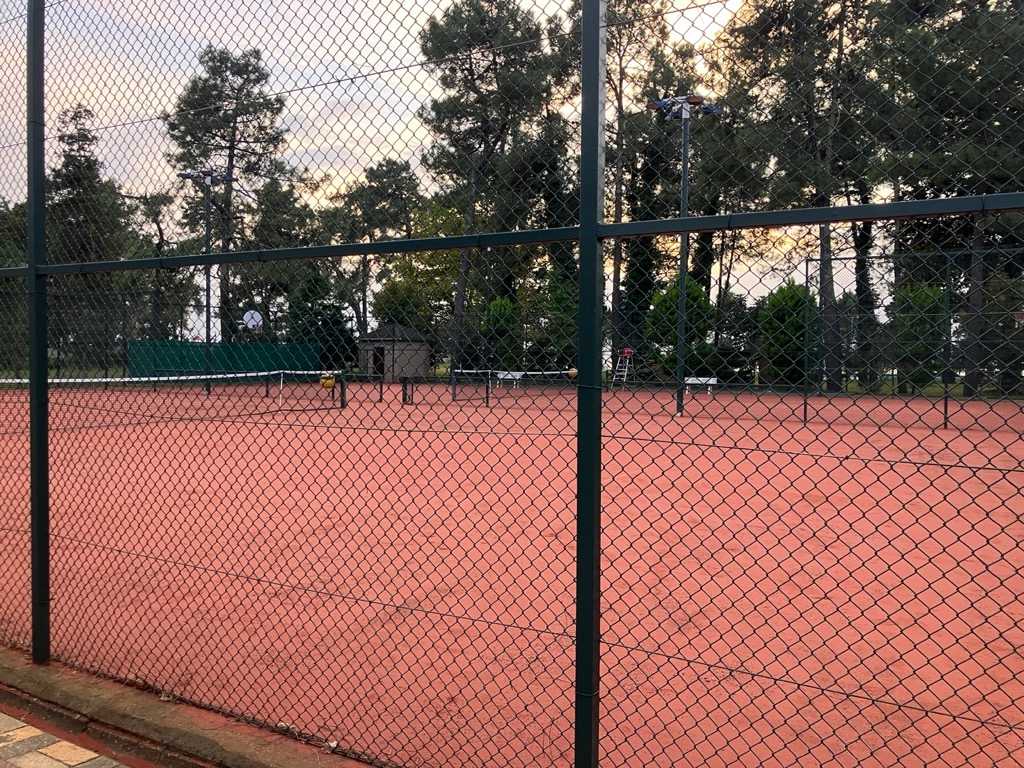
If you are interested, this is how the rest of the hotel territory looks like.
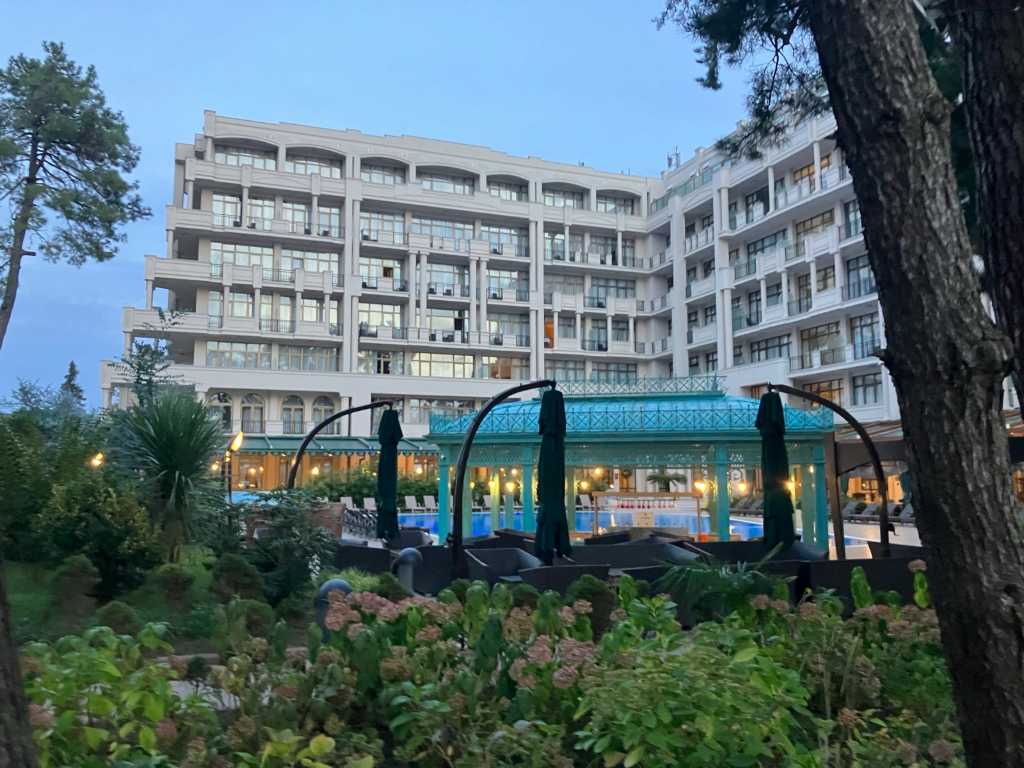
Staying overnight at Georgia Palace Hotel is rather expensive – 300 GEL/night with possible discounts for longer periods of stay, but fairly good accommodation on the order of 70 GEL/night (double room) is available within just 5 minute's walking distance.
You may be wondering why everything takes so much time. Well, I've always been slow and steady to win the race, let's say, but the lung inflammation after an apparent bioweapon attack in Tallinn in 2019 has made the time I need to deliver results of my creative work outright catastrophic.
Kobuleti is a sea resort with a magnetic sand beach stimulating blood circulation among other health benefits, plenty of attractions for children during the season and the grape, feijoa, mandarin, and pomegranate seasons starting right after it. The cultural surroundings offer plenty of valuable learning opportunities for non-arrogant tourist families from American and European extreme capitalist hollowed-out societies at this point of time to get some ideas of how to brush up their percentage play skills in a totalitarian world driven by war-loving pedophiles with a shallow cultural background.
Andres: You can scroll down to find out, but in order for our tournament content to be able to scale beyond the ten thousand word limit of free labor per soul health project – and that's the current reality rather than just a joke, – a lack of resources is needed to be overcome. You are welcome to pay for participation in our Opinion events and taking preparatory or complementary instruction as needed, and/or donate to the following account to keep soul health projects like our Opinion up and humming:
Thanks for Your wise support! You are very welcome to continue reading what you are supporting now.
[retaining wall area – as a reader, think of it as a friendly forgiving paywall (without the quotation marks, preferably) area]
To give credit when credit is due to the female half of our tournament core values design six-pack of brilliant Substack minds and to give this overview some extra kick to support the counter-canceling of what needs to be counter-canceled properly, the spirit and philosophical design of the Kobuleti Opinion 2026 substantially draws from the design patterns presented on the stacks of another three carefully selected fighter hedgehogs.
None of these philosophies may be new to you and this core values introduction has been very sinister so far, so in order for this important piece of introductory reading not to become too boring or depressing for all the joy addicts out there, peeking behind the paywall, and to include some refreshing multidimensional dialogue between Miss X, Y, Z, and beyond from Substack mainly to keep everyone honest in the following, let's call the "paywalled" or retainingwalled dimensions of this dialogue the philosophies of Miss Carrier Hen (as Carrier Hen is probably a central figure of the next six-pack on the Keeping You Honest timeline on Substack should the readers decide to finance it unlike their embarrassingly past-due share of the teamwork for driving the abusers of authority out of power, here comes a short untranslated preview of this homemade local central authority to give all the joy addicts on board a little homework for building some character) and Miss Nike Virus (one of the so-called intelligence providers out there who somehow fails to think before acting every once in a while, yet providing a lot of interesting practical insight in the abuse of authority that our tournament is designed to troubleshoot) for invading the Sun, and free contrary online help by Miss Öz Disiplin (meaning Self-Discipline in her cryptic language, according to the translator being used on Substack) for everyone to keep their feet on the ground, accompanied by a few contributions from other brilliant Substack minds with the insight that helped design our Opinion accurately. Are you entertained enough and joyous now?
As referred to above, according to Miss Carrier Hen, we should start off by separating opinions from self-worth. If you have insomnia then you should listen to her monologues for hours on end on topics ranging from dissecting the human soul with the commitment of an inveterate fighter hedgehog – for a thorough understanding of why it is so important to carefully choose an appropriate spirit for a respectable soul health event like the Kobuleti Opinion – to functional situational awareness and many other topics covered on her stack that are relevant to our Opinion, too. With a competitive spin on them, these topics can easily be adjusted to our purposes. Regarding the engineering of a suitable plasma cloud for our Opinion, for example, we can observe that unlike in Kobuleti at the moment, there is no respectable soul health elite in power in many countries around the world, so let's call the Kobuleti Opinion a respectable soul health elite event for the time being.
If one piece of all the work of Miss Carrier Hen on Substack described the current linguistic significance of our Opinion poignantly, that would be the Russian anecdote about Little Hedgehog that concisely and accurately describes the deciding gap of trust between the half of each of us strong in theory and the other half lousy in practice, you know. Let's call this gap our lack of trust in AI and other useful idiots, or just hedgehogshit or HS for short. Additionally for our purposes, let's define HS as the deciding difference between those of us who should be our reliable soul health elite and those who should find themselves among all the stupid peasants, the reckless aristocrats, HI (AI in our outdated terminology), and other unprincipled aspiring little hedgehogs who are clearly not in the position of teaching us integrity and thus not eligible for anyone's elite status. Any idea what the consequences of aligning your manners with, say, the hedgehog elite (the non-elite and the fake elite combined, that is) might be on a tennis court and later on the worldwide Web for generations to come?
First of all, where and why have things gone decisively wrong on the pro tour, which the provocative enough embedded remix above of what has been covered in the respective section of the tournament regulations demonstrates in turn, and elsewhere for that matter, including one or two rivalries in the reality of our little side-trickle tournament already, after barely having commenced? Well, usually having a tad more focus on things like not being stupid between the points after the abuse of a toilet break is more relevant than your opponent being "a small kid who doesn't know how to fight". And by the way, wouldn't keeping their focus on tennis in tennis matches help the Russian talent show more in their national tennis results than just one or two months at the top of the rankings every time they get there, according to my fair enough interpretation of the list of ATP number 1 ranked singles tennis players? The situation on the women's side isn't much better either, raising valid questions about responsibility and the kind of stupid joy popular with a nation inhabiting a considerable part of our entire planet. Tennis is like a little child requiring your full attention – once you start losing it, you start losing against more opponents at your level of play immediately. Looks like the cheap distractive hubris that shaped this spicy epic rivalry on the pro tour after the toilet break is a combination of cultural differences and the abuse of the abuse of a toilet break, which serves as a lesson well beyond the domain of tennis where our attention needs to be while competing for an adequate place in the rankings.
Against the backdrop of the frequent corruption of the elites of the rest of the world, as we are currently witnessing, and to the credit of the Russian cultural peculiarities not being harnessed for the abuse of toilet breaks, subscriber lists, and what not, it must be added that a tad more professional ways of pointing out problems with these elites than what the Russian professional tennis players have come up with so far would serve as an important reminder and a timely whistleblower, and therefore had better be there to keep many others honest. With 4 wins over and 4 losses to Daniil in the last six-pack of years, Stefanos has finally proved convincingly that he is not a small kid who can't fight with the racket and the ball – at least when compared to the provocateur above and, well, a very educaative opponent in tennis indeed, – which ought to be the scope of tennis matches on the pro tour as well as those at our Opinion for that matter, so the question now becomes, when are the Russians going to do their homework and get up to the task in the domain of tennis, especially considering the combo of a big mouth and reckless policing habits of quite a number of them? How about a little Sampras or a semi-Djokovic from Russia for a change? Or a Graf or a Seles on the women's side?
Until we don't have one, we should generalize the de-souling "elite" to the abuse "elite" whenever we talk about our problems with the fake elite, which is a very inconvenient step back and a shame for the de-souling resistance camp indeed... Which is to say that our camp needs a more adequate top-seeded Russian to avoid insincere, hypocritical, and abusive evaluations of their opponents or treating them as kids or whatever on the same basis that result in responses along equivalent lines from their opponents, obviously, essentially referring to dilettantism among the Russian elite of tennis professionals. Therefore, let's still have our opinions at our Opinion, but do our homework rather than expecting everyone else down the rabbit hole to do so, and that's it.
Generalizing this unprincipled shit back to the off-court domains of our life, well, all too many of us try to avoid responsibility and criticize the world the Little Hedgehog way, especially after having changed the winter tyres of their truck again, let's say, as a poignant comparison with ex collectors. Reckless people can surely keep calling it the most important relation of their life, but this comes at the cost of not being trustworthy anymore in a situation where everybody seems to be guilty in public except for the one being responsible in private, judging by their responses or the lack of them to inquiries about their choices of choosing to act like an asshole when managing their subscriber lists, for example, and then typically finding their way to women's rights movement or similar to further contribute to the mess of simply being unprincipled, shaping our societies accordingly for the stupid "joy" of the freemasons to corrupt the world for more control, you know, and that of all the motormouths out there who always go with the mainstream to amplify this mess for everyone to "enjoy" in the future. See why we can't afford hedgehog elite instead of a trustworthy one?
Please see the disclaimer above again, thanks. In addition to the advice already given to avoid slippery slopes between the points in a match, in tennis the break points are naturally there to help break the stupid peasant mentality of our aspiring educational hedgehogs, which is a good reason for them to participate in our Opinion to train their weaknesses at the moments when it matters most. In the long run tennis is really unforgiving to the players who lack the dignity to pull themselves together at these points (while being on the defensive, of course, like the guy talking to Officer Barbrady above). Our habits do have a lot of power, and those of the stupid little hedgehogs between the points will sooner rather than later dominate our talent during the points. In other words, dine at home as if dining with the king so you can dine at a king's palace as if being at home...
To draw yet another fairly illuminating parallel from the world of stupid little hedgehogs into the world of genuinely successful intimate human relations here, well, it looks like at least the toilet break equivalent of a jeweler is missing from Miss Carrier Hen's list of a lawyer, a guy who just walks away, and what not, so let's zoom in properly here and call it incomplete context as long as more honest stats about her break points not saved are concerned, skipping the subscriber list problem and other headaches altogether to keep the read short for now, to troubleshoot our up-and-coming educational institutions properly right from their beginnings. As our road to hell is paved with good intentions, we'd better be careful even with what from OUR tree stump might seem negligible integrity stones to pave this road with, let alone when teaching others how to do it properly as even a relatively little bit of such academic, say, HS is a source of distrust in our institutions, currently infected with the woke parasite... But trust is everything, right?
And to further dissipate the smell here, there is a useful concept in systems engineering known as the separation of concerns. Apply it to tennis and you'll get an interesting result – talent and genuine, long-term success are separate concerns. Which is to say that you can be very skilled at hitting a tennis ball with a racket, but there are plenty of opponents in the world capable of demonstrating on court that talent isn't enough against a percentage play specialist with a lack of technique. It can well be a deeply humiliating but a very, very educative experience. As you can see, there are many reasons why we call tennis elite sport or reliable soul health elite sport for that matter automagically, without thinking much about why – yet another reason to participate in our Opinion and find out about the magic of being a sport for the elite or equivalent on your own. Until then you'll have pretty much no idea why your talents won't qualify for a place in our reliable soul health elite, alright.
By now, for most of you not really trying to become better students in tennis and many other realms of our life for that matter, the challenge of belonging to our soul health elite or equivalent might already seem too much to take, but you should think about it this way that if all the other instances of the Hedgehog sapiens around aren't a tad more determined to keep each other honest than the ones in Miss Carrier Hen's echo chamber then our good intentions are inevitably going to result in the corruption of meaning and the distortion of our language that we are using about our beloved villain and everything else in the world that matters. That's, by the way, how a true – yet extremely triggering toward the opposite – women's rights activist like the original Carrier Hen quickly and decisively degenerates to a counterfeit women's "rights" activist like Miss Carrier Hen, apparently, accompanied by a huge mess of appearances and all the wrong decisions being made that follow due to assigning meaning just for someone's reckless joy of abusing context, no matter what their social status within all their echo chambers worldwide happens to be.
In other words, context abuse is cheap, and there is always responsibility involved, no matter what the racket, the balls, the weather, what your opponent forgot to say after a lucky net cord, or whatever, and the presence or absence of it is the ultimate game changer at our reliable soul health elite event and in tennis and life in general. Therefore, let another masterpiece of the literary legacy of the great Mark Twain below illustrate the corresponding vulnerability of a crowd of unprincipled little hedgehogs. The mass of uneducated people and the lack of moral values that comes with it has been the worst abuse of capitalism for a long time already and is the most important difference between the two homelands of Miss Carrier Hen, by the way, widely known as the phenomenon of the stupid American. It's about genuine education for the median person (the society, that is) vs government schooling aka brainwashing, basically, which have pretty much nothing in common. There was brainwashing in the Soviet Union too, of course, but it was not the kind of self-satisfied arrogance that destroys the will of stupid little hedgehogs to learn to use their brains and heart much more efficiently than any economic hardships are capable of.
By and large, the problem with the so-called American cockroach sapiens, after having been conditioned by government schooling, consumerism as its driving force, and other abuses of capitalism, is becoming UNPRINCIPLED well beyond the premises of the government. An unprincipled person – unprincipled due to their lack of genuine education, that is – is simply not assigning meaning properly (and shame on those, of course, who do have good education yet abuse context to assign meaning incorrectly anyway!) and as a result will pretty much surely end up under the yoke of a fake elite waiting for the opening, which our Opinion is designed to help avoid at soul health level, because if we fail to act with integrity in real life without sufficient preparatory matches on tennis courts, for example, then the abuse of authority and all the criminal mess that is about to follow naturally is exactly what we deserve as individuals, as a society, and as a species, to be honest, the stupid peasants and the reckless aristocrats alike.
It is the invisible world that matters most, okay, so that's why we don't even have any material prizes at our Opinion in order to let the importance of our soul health sink in properly and help keep our focus on what's most important only, both at the tournament and in the rest of our life, to be honest. As an example, the woke activists at Maltech have clearly and convincingly demonstrated to our Tennis Contacts community over there that the goal of their interpretation of protecting someone's rights serves only one purpose – the hijacking of administration for the benefit of the overseas ideologists who in effect control them by means of bribery, apparently, leading to the use of military style propaganda on innocent people at the university for canceling, bioweapons to brutally silence them thereafter, and any other nasty consequences that crawl out of such a wellhead naturally. A rushed and incomplete report and its quick-n-dirty cover story give you a preliminary idea about what happened to us, but it will be structured and completed properly after the first event of our Opinion for a more rigorous take on the counter-canceling of the individuals responsible as well as the highly criminal woke movement or scam art triggering all these criminals that has used up any reasonable measure of trust in this movement being non-destructive.
A logical question that anyone having been canceled at a DEI whim arrives at here, of course, is why does Miss Carrier Hen keep strategic information for counter-canceling these robots as a team behind paywall... Regarding the robots that Sun invaders like Miss Carrier Hen declare to be fighting, however, in the world of algorithms we have adaptive control, optimal control, fuzzy control, and what not, so after several times of stumbling across her lack of integrity, it looks like we have an algorithm for Carrier Hen control or trust abusive control to be added to the list of classics. The algorithm is trivial – push an unsupported agenda by eliminating due context to make the end justify the means for an unsuspecting or zombie crowd. Does it quack like stealing e-votes at totalitarian elections known as democratic elections in the lingo being pushed currently? Or bribing corrupt politicians in 2014 to shove gay "rights" down the Parliament of Estonia? In other words, with a little bit of abusive scheming, a robot guided by such a control system, or a little hedgehog with the equivalent going on between the ears, can end up doing just about ANYTHING at a whim. Which is to say that such a gambler can't be trusted. See why most of the shit we are currently stuck in boils down to the ABUSE OF CONTEXT?
As a very modest and in this concrete case a potentially inappropriate example to illustrate the problem (in the domain of divide and conquer, by the way), to contrast it with many other, much more urgent ones for added clarity of the full potential of the culprit here, let's see how lofty propagandist assumptions about someone's intentions (the context) can undermine trust. Well, maybe the word "save" here doesn't mean protecting someone from injustice in a marketplace or in a similar context? What if it means restoring someone's trust in a spiritual context instead, such as convincing someone to stop abusing her talent for painting a distorted view of the problems behind her failures with inadequate words for all the slow-wits in our current worldwide mess to see and act upon? Or what if the aforelinked consumerism of the Americans is the culprit here, meaning the Anerican women in particular? And so forth... See why it is important to learn to listen to other people who often have a very different but valid perspective from what we expect, especially if we are arrogant about our own opinion vs the rest of the world? We can call it context-abusive control, too (this term comes close to abusing one's subscriber lists, right?), although it is already widely known as the Invisible Touch or just pouting.
It doesn't matter whether a carrier hen abuses context inadvertently or deliberately – sometimes she just needs to look in the mirror and work with the dominator that she sees there anyway. And it's exactly the same in tennis, where in order to beat your opponent or at least put up a good fight, you need to beat yourself first. Building some character for your inner beast instead of patching up your facade, i.e. your interface for deceiving the unsuspecting public (again, inadvertently or deliberately – doesn't matter), is the way you can eventually start skipping all the stupid childish self-checks for breaking your problem habits on a tennis court without, say, anyone noticing. Failure to qualify as a non-bitch like this is probably the most fundamental reason why women's "rights" fortunately haven't gained as widespread support worldwide as the masonic cult, systemically corrupting as many women as they can (scroll down to "since we cannot get rid of women, let us corrupt them with the Church" to get an idea how), and all their satellite slow-wits have been demanding. By now, getting rid of such systemically calculated and generated corruption, i.e. attitude problem, has become self-discipline or spiritual stamina homework for the carrier hens – learning to listen and being principled rather than recklessly demanding more than your fair share. Don't be a cheater, a pathetic proxy dominator, and a trigger for shit to happen for that matter, alright.
Although the aforelinked Carrier Hen's song about the importance of Carrier Hen with respect to the rest of the world probably didn't have any intent whatsoever to mix with nefarious masonic scheming, it seems to have been a mighty trigger for the stupid little hedgehogs to veer even further into the reckless territory in reality due to a lack of a healthy sense of humor. In the early days of when this attitude started spreading in Estonia and evolving into a problem as it entered the European Union in 2004 – where ethics became pretty much a taboo in education, to the stupid joy of extreme feminists, – men were joking that it's not normal when a control freak mother knows everything about what happened at school before her son comes home. This joke back then about the Carrier Hen mentality being turned into a monster by extreme feminists, who apparently were generously bribed with foreign capital that should not have gone unnoticed, has ended up in obedience apartheid of misandry stripe for entire societies in Eastern Europe, or Sorosian Europe in this context, meaning the canceling of disobedient people (which in reality means men, predominantly) and covering it up with the secret use of bioweapons and other criminal enforcement methods along these lines for the hijacking of any kind of administration, to strangle fair dissent before receiving any widespread attention, apparently.
That's thief mentality taken to the extreme and, with any opposition having been and being brutally eliminated, a highway to consolidating a totalitarian regime that is secretly optimized for stealing, of course. And not surprisingly, Estonia's new president, for example, has been a leading proxy in this business for many decades already, which happens to be rather well documented, by the way, so now you know what to expect during the next 5 years from the local freemasons of the Impoverished Land of the Million Little Thieves, badly needing a war and an enemy to cling to their corrupt pathetic power, who have pivoted yet another proxy of theirs to the highest position of power in Estonia. Her response to our complaint about the utterly mean, unjust, and, from any non-corrupted point of view, absurd hijacking of the Maltech tennis court administration was completely bureaucratic (remarkably unjust, that is) distancing from the case, despite having been contacted at the position of the Chancellor of Justice several times about a plain and simple robbery and a total breach of contract, in effect bribed by the billmasons (overseas freemasons from Microsoft, a Bill Gates company, that is).
Consequently, seems that the consensus within the cartel is to avoid any communication outside their control – a "don't talk to the disobedient to their gang of thieves" mentality. The reality in Estonia at least is that the homeland of the disobedient-to-the-whim has become uninhabitable for them due to the worst proxy screwworms being equipped with bioweapons and what not. Which the brother of the new president doesn't seem to be fully obeying though as he has been playing tennis with us for almost 2 decades by now and hasn't quite left our community yet despite everything. His sister is a senior member of the gang though, so expect more of what you are seeing already. It's going to be ugly, most probably, so lets try to make it as transparent as possible, to keep this rot wired up in a negative feedback loop properly.
Coming back to the remaining contributors to this rather lengthy retainingwalled section of our core values overview already (sorry, let's try to keep it way shorter now), cartels or gangs consolidating totalitarian power like this have much to do with notably reckless (or simply stupid, doesn't matter, the common nominator being the arrogance that accompanies positions of power here) actors often found at the intelligence departments of increasingly corrupted governments, educational institutions, and other positions of intellectual influence who in Estonia tend to block their shortcomings from becoming public notably abusively of their position, so let's expose their soul health problems and the rot accompanying it with the help of an American intelligence hedgehog who at least seems to be trying to be honest so far unlike her Estonian colleagues.
The intelligence bureaucrats, typically lacking adequate insight in other people's work that is often very relevant to dealing with our current problems, tend to assess them in the "emerging with an inflated sense of entitlement, intelligence, and self-importance, even though their so-called expertise is about as useful as a soggy piece of toast" fashion. And it seems to be the same attitude problem in any part of our, say, Stealing Empire, be it in America or in Europe – exactly the same stupidly denigrating style. As for the Americans, such a stupidly discouraging word is even culturally surprising. Sometimes such brain farts seem to be part of a large-scale cover-up while at other times, interestingly, some of these bureaucrats happen to have some ties to reality and seem to exhibit the learning skills of rather good students after having been hit with some profound negative feedback concerning their stupidity and unprofessionalism appropriately. After blocking their stupidity from getting in the way of OUR wprk, the next concern with these folks turned out to be what this kind of arrogance, plasma cloud, or whatever you prefer to call their attitude problem is capable of causing other, say, "ants" to be crushed, even at primary schools, in addition to the ones at our universities.
Needless to say, the level of soul health we are dealing with in these two examples definitely doesn't qualify for a place in any kind of respectable relations, let alone international intelligence relations, so that's general soul health homework for the robo-rabbits, irrespective of their position and skills, before being eligible to participate in our friendly and considerate community backed by a multitude of opinions as our "soggy piece of toast" and other people's, well, valuable teamwork efforts actually start making sense to them in a more respectful and truly intelligent manner. Other than her denigrating style, Miss "Just Do It" or Nike Virus is a great contributor, except for her Sun invader ambition similar to that of Miss Carrier Hen's, and a fairly good student so far, with a failure in thinking before doing every now and then, so extra homework for Miss Carrier Hen is to keep her honest in that department, and vice versa as far as keeping the gap between theory and practice reliable is concerned.
The problem with RRI boils down to the observation that in real life, a lot goes wrong every day, and that's when we need to be creative and up to the task ourselves, without algorithmic or other soul health incompatible "assistance", which at its very core decisively boils down to self-discipline (character and respectable soul health being the proper synonyms here). We often need to be human, and there should be no RRI in the way for our soul health muscles, let's say, to atrophy to the level of someone communicating in the spirit of the above quoted brain fart for just a power play. Furthermore, according to the philosophies of Miss Nike Virus, we'd better avoid the overpopulation of our soul health elite, which is a core value in the design of our Opinion. Also importantly, to be less of a wannabe resister of the abuse of authority, one had better not hide their discussions and opinions behind paywalls, be they reasonable pieces of advice to be taken note of by as many readers as possible or counter-productive brain farts to be troubleshooted properly as a learning experience for everyone following. Put your soap operas behind paywall, for example, but teamwork information along the lines of how to expose and resist the abuse of authority had better be freely and readily available to everyone, thanks. Pretending to fight from behind paywall like a cosmonaut on the Sun at night doesn't make sense for the vast majority of us.
Ever heard about the New World trick? It's just another name for the Hegelian dialectic to try to make you believe that it isn't. Imagine the abusers of this dialectic trying hard to distort our current reality into a nightmare, so you buy the idea of a new world. And once you realize that the new world is even worse than the one before, the process is repeated, of course. That's probably why the New World propagandists are called screwworms.
As an example, imagine a regime change being pulled off by such screwworms in Kobuleti in the winter of 2022/23. You can see the police patrolling the streets, demanding that everyone willing to keep their businesses open take a jab or lose their income, so the folks finally start doing it, as the police pressure mounts to the point of no way out. Within hours after one of the first jabs, your friend calls and asks for help as her blood isn't clotting anymore. You drive to her home and realize that you don't have the required skills this time. Neither does anyone else around, to be honest. You try to do something about it anyway and after a week of struggling in vain you end up at your friend's funeral with the nudging feeling that a gang of screwworms somewhere need to be troubleshooted decisively. That's the harsh reality of not a very distant past, right? The police seem to be kept on short tether now by the local people, so it doesn't seem likely that the government can to pull off another antithesis like that in Kobuleti in their totalitarian dreams-come-true of such a population control campaign and getting well bribed for such crimes on their own people from the funds of some utterly corrupt overseas international terrorists.
It is easy to see that we should cooperate to keep the New World screwworms honest and out of business the way it seems to have finally worked out in Kobuleti, largely thanks to the religious inertia of the local society. By doing :)
* * * TODO: more about self-discipline * * *
In summary, in order to overcome difficulties, one needs to be a good student, listening and paying attention before being able to come up with helpful opinions. As they say, when the student is ready, the teacher will appear. And the teacher we need to appear in our current era of distortion, confusion, and destruction, considering the near-zero input to the Keeping You Honest project on Substack from the REGULAR READERS so far, is clearly TEAMWORK. The additional problem with us, the RESISTANCE WRITERS though, if not getting skilled at teamwork, is that our precious GOOD INTENT might easily and literally get harvested with us if we don't watch out and have an opinion on time regarding the self-discipline of the average Joe not giving a shit. Thanks for all your input, which was very professional, helpful, and much appreciated, and please feel free and special to fly over and enjoy participating in the tournament that you helped design!
DISCLAIMER: Against the backdrop of the way the three stout fellows of someone's poorly designed community got harvested, our Opinion is not an event for all the little hedgehogs of the world to get together on the big red couch, watching the television while sitting next to someone insisting that it was time to buy a television, but for developing the spiritual connection of a community supportive of the spirit of our Opinion and of each other to become better players. Who isn't comfortable with this nor interested in much more than what time it is and where the tennis court is located, please find another connecting spirit for your circles and, preferably, a more adequate sport for your level of play among the spiritual class of little hedgehogs with a range of intentions that naturally serve all too different purposes than ours, thanks!
➤ Back to the top (shortest) layer of this threefold intro
As the pros have put it, tennis is 95% mental, so we shouldn't skip competition at recreational level either, but now let's explore the remaining 5% of this game that makes the rest of it possible – the technique.
Tennis stands out as a very technical sport when compared to other ball games. To start with the overarching technical basics, in tennis – much like in many other sports – power starts from the ground up. For tennis footwork instruction, please see the corresponding Tennis Contacts website with an instruction program already designed for the Batumi Boulevard tennis courts community.
On the Tennis Contacts website for the Kobuleti seaside promenade tennis court community, let's focus on the groundstrokes and other basic instruction for recreational tennis players missing from our footwork instruction website. The latter was designed for young potential professionals in the situation on the Batumi tennis courts back in 2025, but is fully suitable for everybody else willing to ground their movement on court in sound overarching technical basics, too. And in addition to the topics already covered on these websites for learning or improving your basic skills for success in this sport, our annual tournaments will help put it all neatly together at recreational level of play.
Instead of making the typical mistake of, say, bad professional tennis instruction and allocate too much focus to hitting the groundies on the baseline too early, it would be wise to elaborate our footwork discussed on the Tennis Contacts website for the Batumi Boulevard tennis-loving community and develop some touch of the ball on top of it with the help of volleying at the net for getting prepared for not just covering the baseline with sound footwork but also hitting at longer distance with the touch and accuracy that comes with mastering life at the net first. Here is how:
Introduction to the modern groundstrokes technique is a good starting point on the baseline, and here is yet another sound piece of instruction by Rick Macci available online at the moment, to get started with the forehand:
Despite everything, in many aspects you can think of the modern two-handed backhand as a lefty forehand with added power if executed properly, in addition to the differences between the two. Here you can learn about some key details about the latter mostly:
The one-handed backhand is different from the above two in that the bigger muscles run the show. Here are the details:
You might want to take a look at entries #3 and #4 in the Response to Feedback section with answers to a couple questions asked about the groundstrokes so far to learn more about the forehand and the backhand stroke techniques.
The slice. Something else you are going to need on the baseline is the slice. Interestingly, the forehand and backhand slices are most probably going to feel more different to you from each other than the volleys or the groundies off the opposite wings:
There is surely one more stroke that can't be left out of the list of the bare essentials. First of all, a great serve starts with a great toss, and so does every point in tennis. Technically speaking, the guy to listen to has found a great role model among the pros for us, in this case on the WTA tour. Here he shares some nice historic background for and important helper insight into this part of the serving technique:
is another good one in slow motion:
We have just covered the first stage of the most complex stroke in tennis. Regarding the shoulder turn, the trophy position, the push-up, and finally hitting the ball as if with a threshing-flail, here you can see a few more excellent role models in addition to the ones presented on the BB footwork instruction website to help you with assembling a sound serve stroke optimal for your purposes:
Additional basic stroke technique descriptions and videos with role models for homework might be added here as our lessons advance. A few aspects of the serve, the smash, and the volley strokes have been covered on the footwork instruction website already.
There have been many excellent questions from participants at the lessons we've had so far. Some of them are discussed below in more detail as homework for everyone interested.
Let's start with an extreme example and in general not necessarily good advice here – the unique forehand of a very rare type of player with an extremely flexible body who points his hand towards his opponent on forehand shoulder turn and is seemingly still capable of playing ridiculously well against Rafa on clay, for example:
Turns out that insufficiently deep shoulder turn on the forehand side is the most common source of errors among the recreational tennis players, so the obvious advice here is to turn your shoulders more like a typical pro. Just in case, take a look at the outstanding forehands of a couple more of them below:
In a nutshell, if you don't have the talent and flexibility of Gulbis to bagel Rafa on clay in the opening set or similar then a complete shoulder turn combined with focus on perseverance is even more likely to pay off than what we saw happen in their match highlights presented above. You might also benefit from listening to the highlights of the post-match interviews with both opponents.
In addition to the couple serves presented in slow motion on the BB footwork instruction website already and the five ones above, let's add a couple more video clips for helping do your own research, starting from the other extreme of the spectrum this time:
And let's end our tips for finding your optimal shoulder turn for the serve with examining the serving technique of the current world record holder of serve speed:
In summary, if turning your shoulders more results in a considerable extra kick to your serve then you should use it.
3. Why should the strings face the ground when hitting groundstrokes? Let's take a look at yet another Macci backhand lesson:
No backhand – no money. And as for the recreational tennis players, it usually pays off to learn from the pros.
4. How to generate power off the ground when hitting groundstrokes? Let's take a look at yet another Macci forehand lesson:
In summary, power starts from the ground up in tennis, so you want to keep your knees flexed, your center of mass low, and your body weight leaning forward before you go up as the very basics of your groundstroke technique.
That's more of the incomplete shoulder turn, basically, but let's zoom in and get a few more detailed tips from the pros on what the usual suspects in this mystery are:
In short, point your belly button to the sideline to put your hips into the shot, and put your back foot down with weight to interact with the ground for plenty of energy to make your shot smooth. The way you put your back foot down in tennis, by and large (compare it to the stance Roger is showing above):
Just imagine you are a little ski slalom champ taking a turn when hitting groundies in tennis as far as your footwork is concerned. The same applies to volleying, too:
In summary, you get the idea that the outside leg is strong and powerful, and that's where you get the weight on your shot from. Which is to say that you have much better control of the ball, or the way Roger prefers to put it, you are smooth on the shot.
6. What is pronation and when is it used? Pronation is part of the serving technique. It is used to prolong contact between the racket and the ball when hitting through it for more racket head speed as well as kick on the ball. Here is how:
For an explanation of terms like the kick serve, hitting through the ball, and so forth, you can do some research on the web, for example, to complete this overview of tennis stroke techniques.
7. How to find the ball, when to show a smile, why keep your racket loose, and other excellent tips on how to improve your stroke technique... Let's take a look at some of the most valuable advice about tennis basics for beginners that other tennis instructors have come up with over time:
You might want to google Rick Macci's, Oscar Wegner's and other insightful tennis instructors' lessons for other brilliant tips on tennis stroke techniques, general hitting guidance, and more.